
Banking gaps for international B2B firms are defined as the structural failures in cross-border financial infrastructure that cause slow settlements, hidden fees, and restricted payment access. Cross-border B2B transactions lose 2%–5% of value to intermediary fees and unfavorable exchange spreads, and they take 1–5 business days to clear. That friction is not accidental. It is built into the architecture of correspondent banking, compliance requirements, and fragmented payment infrastructure that underpins global trade. Understanding why international B2B firms face banking gaps is the first step toward managing the real cost of doing business across borders.
Why international B2B firms face banking gaps: the systemic causes
The root cause of banking gaps in cross-border B2B transactions is the correspondent banking model. Banks that lack a direct relationship with a foreign institution route payments through one or more intermediary banks, each of which charges a fee and holds funds temporarily. This chain adds cost and time at every link.
A less visible but equally damaging problem is the nostro account requirement. Banks must pre-fund nostro accounts estimated between $400 billion and over $1 trillion globally, capital that earns little or no return. Banks pass that capital cost directly to business clients through fees and spreads.
The correspondent network is also shrinking. KYC and AML compliance costs now exceed revenues for smaller banks maintaining cross-border corridors, so they exit those relationships. Fewer direct relationships mean longer intermediary chains, higher costs, and slower settlements for the firms that depend on them.
- Correspondent banking chains: Each intermediary bank in the chain deducts a fee before passing the payment forward, with no obligation to disclose the deduction upfront.
- Pre-funded capital lock-up: Nostro account requirements freeze working capital that firms could otherwise deploy in operations.
- Compliance-driven corridor contraction: As banks exit unprofitable corridors, firms in those markets lose access to affordable settlement options.
- Data standardization failures: Payments frequently arrive stripped of remittance data, forcing manual reconciliation on both sides of the transaction.
- Misaligned incentives: Banks earn interest on funds held during settlement delays, reducing their motivation to accelerate clearing times.
Pro Tip: Ask your bank for a full fee disclosure on any cross-border payment before initiating it. Request the correspondent bank chain in writing. If they cannot provide it, that opacity is itself a cost signal.
How banking gaps affect payment speed, costs, and working capital
The tangible impact of banking gaps shows up first in cash flow. International B2B payments take 1–5 business days and lose 2%–5% of their value in transit. On a $500,000 supplier invoice, that means up to $25,000 disappears before the payment arrives, and the funds may not clear for a full week.

Working capital is the direct casualty. A firm waiting five days for a $500,000 payment to clear cannot use that capital to pay its own suppliers, fund inventory, or service debt. If that firm relies on a credit facility to bridge the gap, the financing cost compounds the original fee loss.
| Impact Area | What Happens | Business Consequence |
|---|---|---|
| Payment transit time | 1–5 business days per transaction | Delayed revenue recognition and cash flow gaps |
| Fee erosion | 2%–5% of payment value lost | Reduced margin on every cross-border sale |
| Reconciliation labor | Payments arrive without remittance data | Manual matching adds hours and error risk |
| Credit facility reliance | Firms borrow to cover delayed receipts | Financing costs stack on top of transaction fees |
| Acquirer underwriting limits | Average B2B payment ~$40,000 vs. acquirer limits near $10,000 | High-value transactions get blocked or fragmented |
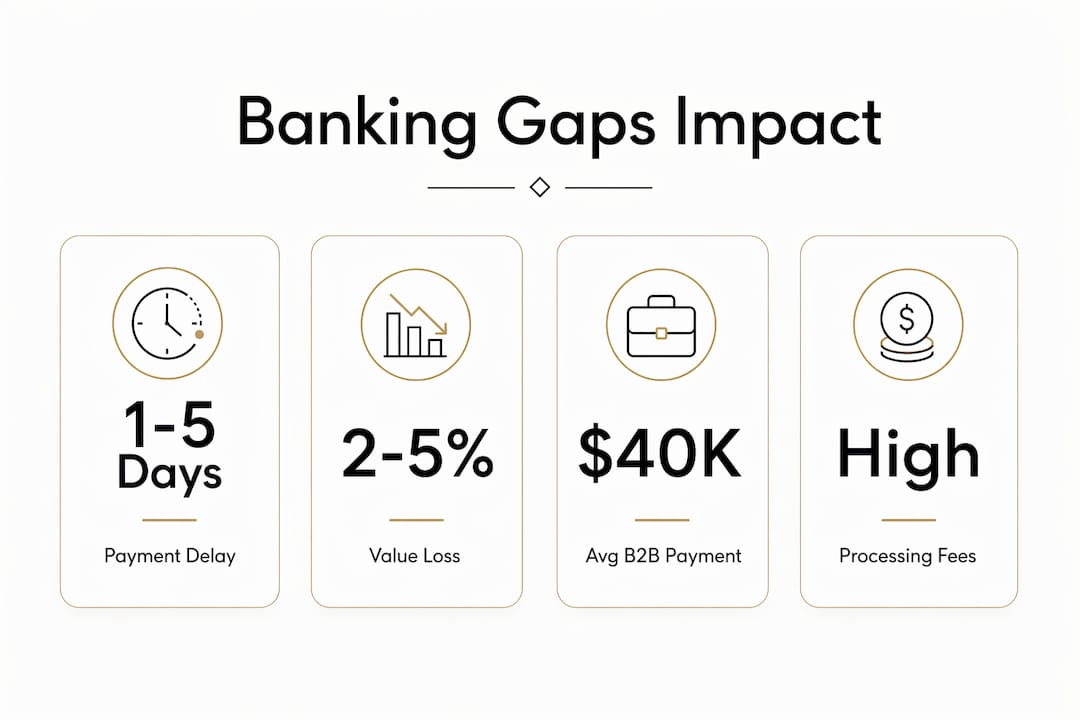
The acquirer underwriting mismatch deserves attention. The average B2B payment sits around $40,000, but many acquirer underwriting limits hover near $10,000. That gap forces firms to split transactions, multiplying fees and reconciliation work.
Pro Tip: Map your top 10 cross-border payment corridors and calculate the total cost per transaction, including fees, FX spread, and staff time for reconciliation. Most firms discover their real cost is 2–3 times the headline fee.
Why payment method gaps and fragmented infrastructure make things worse
Payment method limitations are a direct cause of late payments for international B2B firms. One in three suppliers report routine late payments because they cannot offer the payment method their buyer prefers. Two-thirds of suppliers fail to meet buyer payment expectations entirely. That failure does not just delay cash. It damages contract renewal rates and client retention.
The infrastructure problem runs deeper than payment method choice. Here is how fragmentation compounds the damage:
- Incompatible software systems: Buyers and suppliers often run different ERP or accounting platforms that cannot exchange structured remittance data. Payments arrive as wire transfers with no invoice reference, requiring manual matching.
- Localized payment schemes: Markets like the EU, the UK, India, and Southeast Asia each operate distinct local payment rails. A firm collecting from buyers across three regions may need to support SEPA, Faster Payments, UPI, and SWIFT simultaneously.
- Remittance data stripping: Correspondent banks frequently strip structured data from payment messages to ensure compatibility with older systems. The receiving firm gets a credit with no context.
- Multiple currency accounts: Firms without multi-currency accounts must convert every incoming payment, incurring FX costs and creating reconciliation complexity across currencies.
- Manual intervention at scale: Interoperability gaps between buyer and supplier systems generate errors and manual work that accumulate into significant labor costs over time.
The cumulative effect is that a firm's accounts receivable team spends a disproportionate share of its time chasing payment confirmations and matching transactions rather than managing cash. That labor cost rarely appears in a payment fee analysis, but it is real and it scales with transaction volume.
How geopolitical and credit factors deepen trade finance gaps
External shocks amplify the structural banking gaps that international B2B firms already face. When geopolitical crises disrupt commodity markets, banks tighten trade finance exposure precisely when firms need it most. Trade finance demand surged 50% year-on-year following the Hormuz crisis, which doubled commodity prices and compressed credit limits for SMEs. The Asian Development Bank stepped in to fill part of the gap, but institutional support cannot fully replace commercial bank capacity.
- Country and counterparty limits: Banks apply hard limits on trade finance exposure by country and counterparty. When those limits are reached, non-critical transactions get declined regardless of the borrower's creditworthiness.
- Risk-averse credit underwriting: SMEs and mid-sized firms face the sharpest credit squeezes because banks prioritize large, low-risk clients when capacity is constrained.
- Commodity price volatility: Price spikes reduce the purchasing power of existing credit facilities, forcing firms to either reduce order volumes or seek additional financing at higher rates.
- Supply chain financing gaps: When a supplier cannot access trade finance, the entire supply chain slows. Buyers face delays, and the cost of disruption spreads upstream and downstream.
The broader macroeconomic context matters here. Geopolitical instability does not just raise commodity prices. It raises the perceived risk of entire trade corridors, which causes banks to reduce their exposure to those markets. Firms operating in affected regions lose access to trade finance at exactly the moment when they need it to manage supply chain disruption.
What can international B2B firms do to close banking gaps?
Practical solutions to banking gaps exist, and they do not require waiting for the global payments system to reform itself. The most effective approaches combine technology adoption with process discipline.
- Digitize settlement data end-to-end: Structured payment formats like ISO 20022 carry rich remittance data through the payment chain, reducing manual reconciliation. Firms that mandate ISO 20022-compatible formats with their banks and buyers cut reconciliation labor significantly.
- Use local payment rails where available: Routing payments through local schemes like SEPA in Europe or Faster Payments in the UK bypasses correspondent chains entirely for domestic legs of cross-border transactions. Clearing times drop from days to hours.
- Expand payment method options: Offering buyers their preferred payment method directly reduces late payments. Two-thirds of suppliers currently fail to do this. Adding even one or two additional methods materially improves on-time collection rates.
- Align treasury and accounting on total payment cost: Treasury teams focus on headline fees while accounting teams absorb the labor cost of reconciliation. Bringing both teams into a shared cost model reveals the true cost per payment and justifies investment in better infrastructure.
- Partner with niche cross-border payment specialists: Specialist platforms built for international B2B transactions offer multi-currency accounts, FX workflows, and compliance-ready onboarding that traditional banks do not provide for mid-market firms.
Pro Tip: Before selecting any payment platform, ask for a breakdown of all-in costs per corridor, including FX spread, fixed fees, and any intermediary charges. A low headline fee with a wide FX spread often costs more than a transparent flat-fee structure.
B2B payment friction is not a single problem. At least 23 distinct pain points exist across six categories in the B2B payments system. Firms that treat it as a single fee problem apply superficial fixes that shift costs rather than remove them.
Key Takeaways
International B2B firms face banking gaps because correspondent banking infrastructure, compliance burdens, fragmented payment systems, and geopolitical credit pressures combine to make cross-border transactions slow, expensive, and opaque.
| Point | Details |
|---|---|
| Correspondent banking costs | Pre-funded nostro accounts and shrinking correspondent networks raise fees and slow settlements. |
| Fee erosion on payments | Firms lose 2%–5% of payment value per transaction to hidden intermediary and FX fees. |
| Payment method gaps | One in three suppliers faces late payments from not offering buyer-preferred payment methods. |
| Geopolitical credit risk | Trade finance demand surged 50% after the Hormuz crisis, squeezing SME credit access. |
| Process cost blindspot | Manual reconciliation labor often exceeds headline transaction fees and goes untracked. |
The fix is structural, not cosmetic
After working with international B2B firms across multiple industries, the pattern I see most often is this: firms treat banking gaps as a fee problem when they are actually a systems problem. They negotiate a lower wire transfer fee, declare victory, and then spend the next quarter paying their accounting team to manually reconcile payments that arrived without remittance data. The fee savings disappear into labor costs that nobody measured.
The firms that actually close their banking gaps do three things differently. They measure the total cost of a payment, including staff time, financing costs during delays, and FX spread, not just the transaction fee. They invest in infrastructure that carries data through the payment chain, not just funds. And they treat payment method diversity as a revenue protection strategy, not an IT project.
The uncomfortable truth is that the global payments system was not designed for international B2B firms. It was designed for large banks and their largest clients. Mid-market and growth-stage firms are an afterthought in that architecture. The only way to get a fair deal is to stop using the architecture where it does not serve you and find cross-border payment solutions built specifically for your transaction profile.
— Ahmed
How Sigmaplatinum supports international B2B firms facing banking gaps
Sigmaplatinum is built for the exact problem this article describes. International B2B firms, including digital agencies, consulting firms, and import/export companies, use Sigmaplatinum to access business payment accounts that support multi-currency transactions, FX workflows, and structured remittance data from day one. The platform's compliance-focused onboarding, including rigorous KYB checks, means firms get access to regulated payment infrastructure without the months-long delays that traditional bank onboarding requires. If your firm is losing margin to hidden fees, slow settlements, or payment method gaps, Sigmaplatinum's no-code model gives you direct access to the tools that close those gaps. Explore your options at Sigmaplatinum.
FAQ
What causes banking gaps for international B2B firms?
Banking gaps result from correspondent banking chains, pre-funded nostro account requirements, KYC/AML compliance costs, and fragmented payment infrastructure. These structural factors combine to make cross-border B2B payments slow, expensive, and opaque.
How much do cross-border B2B payments actually cost?
Cross-border B2B payments lose 2%–5% of their value to intermediary fees and FX spreads, and they take 1–5 business days to clear. The real cost is higher when manual reconciliation labor is included.
Why do international B2B firms struggle to get trade finance?
Banks apply country and counterparty limits that restrict trade finance availability, especially for SMEs. Geopolitical shocks like the Hormuz crisis caused trade finance demand to surge 50% while simultaneously compressing available credit, leaving mid-market firms underserved.
How do payment method gaps cause late payments?
One in three suppliers reports routine late payments because they cannot offer the payment method their buyer prefers. Expanding payment method options is one of the most direct ways to improve on-time collection rates.
What is the fastest way to reduce B2B payment friction?
Adopting local payment rails for domestic legs of cross-border transactions, mandating structured remittance data formats, and using a multi-currency payment account eliminates the most common sources of delay and reconciliation cost.