
Cross-border B2B invoicing is the process of issuing business-to-business invoices that conform to international tax, currency, and payment requirements to facilitate compliant, timely transactions across country borders. Unlike domestic billing, the cross-border invoicing process demands that every invoice carry verified tax identification numbers, explicit currency terms, legally mandated VAT notices, and complete bank payment details. Miss any one of these elements and you risk rejected invoices, delayed payments, or tax penalties. This article breaks down how cross-border B2B invoicing works across tax compliance, currency handling, automation, and common pitfalls, with practical guidance for finance teams managing international operations in 2026.
How cross-border b2b invoicing works: tax and VAT rules
The most consequential element of international B2B invoicing is VAT treatment. Get it wrong and you face penalties exceeding 20% of the invoice value, plus potential rejection of the entire transaction.
The EU reverse charge mechanism is the standard framework for B2B cross-border services within the European Union. Under this mechanism, the buyer accounts for VAT rather than the seller, and the invoice carries a 0% VAT rate. However, reverse charge VAT applies only when the supplier has verified the buyer's VAT number through the EU's VIES (VAT Information Exchange System) database before issuing the invoice. Without that verification step, you may incorrectly charge VAT, creating pricing errors and compliance exposure for both parties.
The legal wording on the invoice is not optional. EU invoices using reverse charge must include a specific declaration, typically referencing Article 196 of the EU VAT Directive. Omitting this declaration can result in total invoice rejection and tax penalties for both the supplier and the buyer. That is a costly oversight for what amounts to a single missing line of text.
The B2B versus B2C distinction matters just as much. B2B cross-border transactions typically use reverse charge, while B2C customers pay the VAT rate of the destination country. Confusing these two categories affects pricing, accounting treatment, and regulatory filings across every jurisdiction involved.
| Region | B2B VAT Treatment | Key Requirement |
|---|---|---|
| European Union | Reverse charge, 0% on invoice | VIES-verified VAT number + Article 196 notice |
| United States | No federal VAT; state sales tax varies | Resale certificates or exemption documentation |
| Non-EU countries | Varies; often zero-rated export | Proof of export, local tax authority rules |
Pro Tip: Run every EU client VAT number through VIES at the time of invoicing, not just during onboarding. VAT registrations can lapse, and an invalid number at invoice time removes your reverse charge protection.
How should currency and payment instructions be handled?
Currency selection is a strategic decision, not an administrative one. Invoicing in USD or EUR reduces your exposure to exchange rate volatility, but it shifts FX risk to your client. Invoicing in the client's local currency improves their experience but requires you to manage the conversion on your end.

Defining FX risk and transfer fee responsibilities in the contract before invoicing is a best practice that can preserve up to 5% of transaction value. That figure is not trivial on a $200,000 contract. Specify in writing whether the sender, receiver, or both parties bear transfer fees, and document the agreed exchange rate or the rate source (such as the European Central Bank mid-rate on the invoice date).
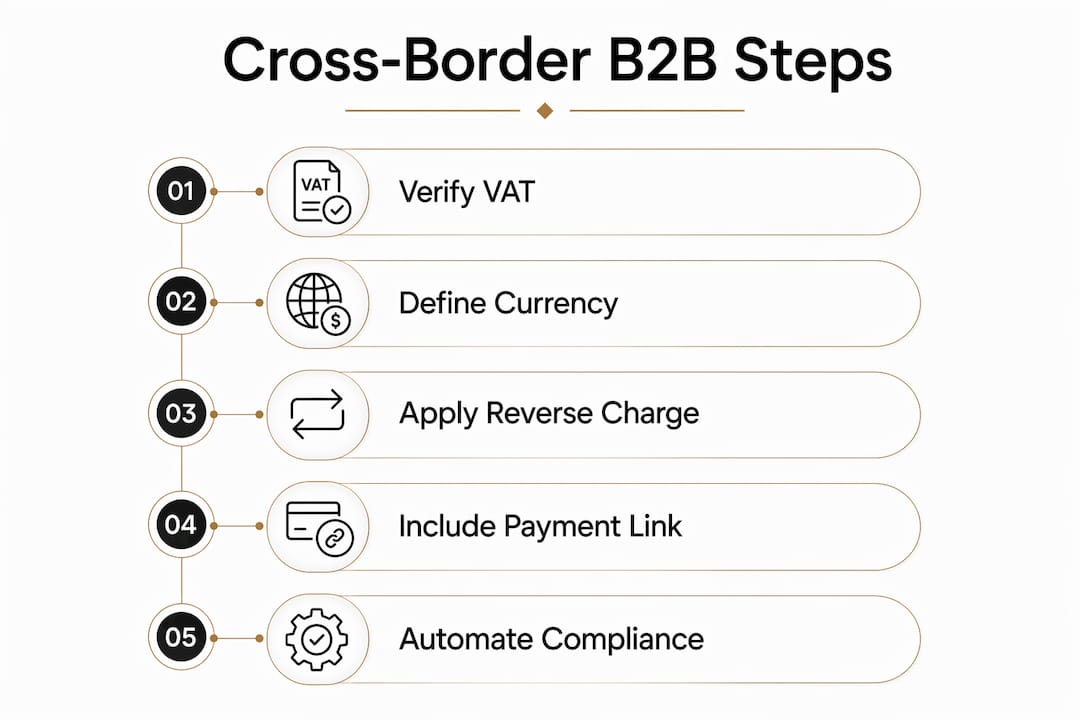
Payment instructions on international invoices must be complete and unambiguous. Incomplete bank details are one of the leading causes of returned international wires, which trigger additional fees and delays. For multi-currency account setups, the required fields are even more specific.
Here is what every international B2B invoice payment section must include:
- Beneficiary bank name and full address
- IBAN (for European transfers) or account number
- SWIFT/BIC code for the receiving bank
- Intermediary bank details if applicable (common for USD transfers outside the US)
- Remittance reference specifying the invoice number
- Transfer fee instruction: OUR (sender pays all), BEN (receiver pays all), or SHA (shared)
- Currency of the receiving account to prevent automatic conversion by the correspondent bank
Including a payment link on the invoice reduces payment delays by allowing clients to pay in their local currency while you receive funds in your preferred currency. Platforms that support this feature eliminate a significant source of friction in the invoice-to-cash cycle.
Pro Tip: Always instruct your client to include the invoice number in the wire reference field. Without it, your finance team will spend hours matching incoming payments to open invoices, especially across multiple currencies.
What role does automation play in international b2b invoicing?
Manual invoice processing across multiple jurisdictions is not just slow. It is a compliance risk. Automated invoice workflows validate invoices against country-specific compliance rules and achieve up to 90% touchless processing rates. That means nine out of ten invoices move from receipt to approval without a human touching them.
The compliance layer is where automation delivers its clearest value. Countries like Italy and France require invoices to pass through government-mandated portals before they are legally valid. Italy uses FatturaPA, a structured XML format submitted through the Sistema di Interscambio (SDI) portal. France uses Chorus Pro for public sector invoicing, with broader mandates expanding to private B2B transactions. Automation systems integrate these validations directly into the accounts payable workflow, rejecting non-compliant invoices before they reach the ERP rather than after.
AI-driven validation adds a second layer of protection. These systems cross-check invoice fields against purchase orders, contracts, and supplier master data in real time. Discrepancies in tax identification numbers, currency codes, or legal entity names are flagged instantly rather than discovered during a tax audit months later.
| E-Invoicing Standard | Country | Format | Submission Portal |
|---|---|---|---|
| FatturaPA | Italy | XML | Sistema di Interscambio (SDI) |
| Chorus Pro | France | UBL / CII | Chorus Pro portal |
| PEPPOL BIS | EU-wide | UBL | PEPPOL network |
| CFDI | Mexico | XML | SAT portal |
Global e-invoicing standardization consolidates multiple accounts payable and accounts receivable streams into unified digital workflows. This gives finance leaders a single view of invoice status across all jurisdictions, which is critical when managing payment terms, cash flow forecasting, and audit readiness simultaneously. For a deeper look at how finance automation workflows apply to cross-border invoicing, the operational benefits extend well beyond compliance.
What are the most common pitfalls in cross-border b2b invoice management?
The most expensive mistakes in international B2B invoice management are not exotic. They are routine errors that compound across hundreds of transactions.
Missing or incorrect invoice fields top the list. International invoices require sequential numbering, full legal addresses for both parties, exact invoice issue and supply dates, and tax identification numbers. Countries like Germany, France, and Italy reject invoices that omit any of these fields. A rejected invoice does not just delay payment. It restarts the compliance clock and can trigger late payment interest under local commercial law.
Incorrect VAT application is the second major risk. Charging VAT on a B2B export when reverse charge should apply creates a double-tax situation: your client cannot reclaim VAT they were incorrectly charged, and you may owe the tax to your own authority anyway. The VIES verification step exists precisely to prevent this.
Undefined FX and fee allocation erodes transaction value quietly. Finance teams often discover the problem only when reconciling bank statements and finding that received amounts do not match invoice totals. Explicit clarity in invoice-to-payment paths, including fee allocation and remittance references, is what separates finance teams that close books cleanly from those that spend weeks chasing discrepancies.
Here is a numbered checklist to prevent the most common failures:
- Verify the client's VAT number via VIES before issuing any EU B2B invoice.
- Include the legally required reverse charge declaration with the correct article reference.
- Specify invoice currency, the FX rate used, and the rate source on every international invoice.
- Document transfer fee allocation (OUR, BEN, or SHA) in both the contract and the invoice.
- Include full bank details: IBAN, SWIFT/BIC, intermediary bank if applicable, and the receiving currency.
- Confirm all mandatory fields are present: sequential number, full addresses, issue date, supply date, and tax IDs.
- Use e-invoicing formats required by the destination country before submitting to the client's ERP.
For a practical look at how these steps apply across different business models, the B2B cross-border payment examples from Sigmaplatinum cover eight real-world setups in detail.
Key takeaways
Cross-border B2B invoicing requires verified tax IDs, explicit currency terms, legally mandated VAT notices, and complete bank payment details to avoid rejection, penalties, and payment delays.
| Point | Details |
|---|---|
| Reverse charge VAT compliance | Verify client VAT numbers via VIES and include Article 196 declarations on every EU B2B invoice. |
| Currency and FX documentation | Define FX rate source and transfer fee allocation in contracts to protect up to 5% of transaction value. |
| Complete payment instructions | Include IBAN, SWIFT/BIC, intermediary bank details, and remittance reference on every international invoice. |
| Automation and e-invoicing | Use country-specific formats like FatturaPA and Chorus Pro to achieve up to 90% touchless processing. |
| Mandatory invoice fields | Missing sequential numbers, tax IDs, or supply dates causes invoice rejection in Germany, France, and Italy. |
What i've learned about cross-border invoicing after years in the field
Most finance teams treat cross-border invoicing as a compliance checkbox. That framing is the root cause of most of the problems I see. The invoice is not just a payment request. It is a legal document, a tax record, and a contract artifact all at once. Treating it as anything less creates gaps that auditors and tax authorities are very good at finding.
The single most underrated practice is contract-level clarity on FX and fee terms before the first invoice is ever issued. I have watched businesses lose thousands of dollars per transaction simply because no one specified who pays the SWIFT intermediary fees. That conversation takes ten minutes during contract negotiation and saves weeks of reconciliation later.
I am also skeptical of businesses that delay adopting e-invoicing automation because their current volume "doesn't justify it." The compliance requirements in Italy, France, and increasingly across the EU are not optional, and they are expanding. Building manual workarounds today means rebuilding your entire process in two years under pressure. The workflow automation tools available now are accessible even for mid-sized businesses, and the cost of non-compliance dwarfs any implementation expense.
The businesses that handle international invoicing well share one trait: they treat invoice standardization as a financial control, not an administrative task. That shift in perspective changes how teams are trained, how contracts are written, and how payment terms are negotiated. The compliance follows naturally from there.
— Ahmed
How Sigmaplatinum supports cross-border b2b payments
Managing international invoicing methods across multiple currencies and tax jurisdictions requires more than a spreadsheet and a bank account.
Sigmaplatinum is built specifically for B2B companies that need multi-currency accounts, FX workflows, and compliant payment infrastructure without the friction of traditional banking. The platform supports IBAN-based receiving accounts, SWIFT payment routing, and structured onboarding through rigorous KYB checks, so your payment instructions are always backed by verified, regulated infrastructure. Digital agencies, consulting firms, and import/export companies use Sigmaplatinum to keep their international payment operations clean, compliant, and fast. If your cross-border payment solutions need an upgrade in 2026, Sigmaplatinum is the place to start.
FAQ
What is the reverse charge mechanism in b2b invoicing?
The reverse charge mechanism shifts VAT accounting responsibility from the supplier to the buyer in cross-border B2B transactions. The supplier issues the invoice at 0% VAT and includes a legal declaration referencing Article 196 of the EU VAT Directive.
How do i verify a client's VAT number for cross-border invoicing?
Use the EU's VIES (VAT Information Exchange System) portal to validate the client's VAT number before issuing the invoice. Without a valid VIES check, the reverse charge mechanism does not apply and you may be liable for the VAT yourself.
What currency should i use on an international b2b invoice?
USD and EUR are the most common choices because they reduce exchange rate volatility for the supplier. The invoice should state the currency, the FX rate used, and the rate source, such as the European Central Bank mid-rate on the invoice date.
Why do international wires get returned or mismatched?
Returned wires most often result from incomplete bank details or missing remittance references. Always include IBAN, SWIFT/BIC, intermediary bank information, and the invoice number in the payment reference field to prevent matching failures.
Which countries require specific e-invoicing formats?
Italy requires FatturaPA in XML format submitted through the SDI portal. France uses Chorus Pro for public sector and expanding private B2B mandates. Mexico requires CFDI format submitted through the SAT portal. Automated invoice systems integrate these validations before ERP processing.