
A business FX account is a corporate banking solution designed to hold, send, and receive multiple currencies in one platform, built specifically for companies managing international payments and currency risk. Unlike a personal bank account or a retail forex trading account, it serves treasury functions: paying overseas suppliers, collecting foreign revenue, and protecting margins from exchange rate swings. Traders and business owners operating across borders face real financial exposure every time a currency moves against them. Understanding what a business FX account is, and how it differs from retail alternatives, is the first step toward managing that exposure with precision.
What is a business FX account for traders?
A business FX account is a multi-currency corporate account that holds and converts currencies across a single platform, replacing the inefficiency of maintaining separate bank accounts in each country where a business operates. Providers typically support anywhere from 12 to over 50 major currencies depending on the platform. That range matters because every unnecessary currency conversion carries a spread cost, and those costs compound quickly at trading volumes.
The core features of a business forex account go well beyond basic currency exchange. Most platforms offer:
- Multi-currency wallets that hold balances in USD, EUR, GBP, JPY, and dozens of other currencies simultaneously
- Batch international payments for paying multiple suppliers or vendors in a single transaction run
- FX hedging tools including forward contracts that lock in exchange rates for future payments
- Real-time balance visibility across all currency holdings in one dashboard
- API connectivity for automating payment workflows and integrating with accounting systems like Xero or QuickBooks
- Dedicated relationship managers for high-volume accounts requiring personalized support
The distinction from retail forex trading is critical. Retail forex accounts, offered by brokers like IG or OANDA, are built for speculative currency trading. A business FX account is built for corporate treasury management, not speculation. The goal is operational efficiency and risk control, not profit from price movements.
Pro Tip: Use forward contracts to lock in exchange rates on known future payments, such as supplier invoices due in 90 days. Failing to use this tool leaves your margins exposed to currency swings that can erode profitability on otherwise solid deals.

Business FX account providers also offer multi-currency payroll, which is particularly valuable for companies with international teams. Paying a developer in Poland in PLN and a contractor in Singapore in SGD from one account, without routing through correspondent banks, cuts both cost and processing time significantly.
How does a business FX account differ from a personal or retail account?
Many traders and business owners initially try to manage international payments through personal bank accounts or retail forex platforms. Both approaches create problems that scale badly as transaction volumes grow.
| Feature | Business FX account | Personal or retail account |
|---|---|---|
| Transaction limits | High volume, often $10M+ annually | Low daily and monthly caps |
| Currency support | 12 to 50+ currencies | Typically 5 to 10 |
| Multi-user access | Multiple authorized users and roles | Single account holder |
| Compliance framework | KYB, AML, corporate documentation | Basic KYC only |
| Integration | API, accounting software, ERP systems | Limited or none |
| Purpose | Treasury management, payments | Personal spending, retail speculation |
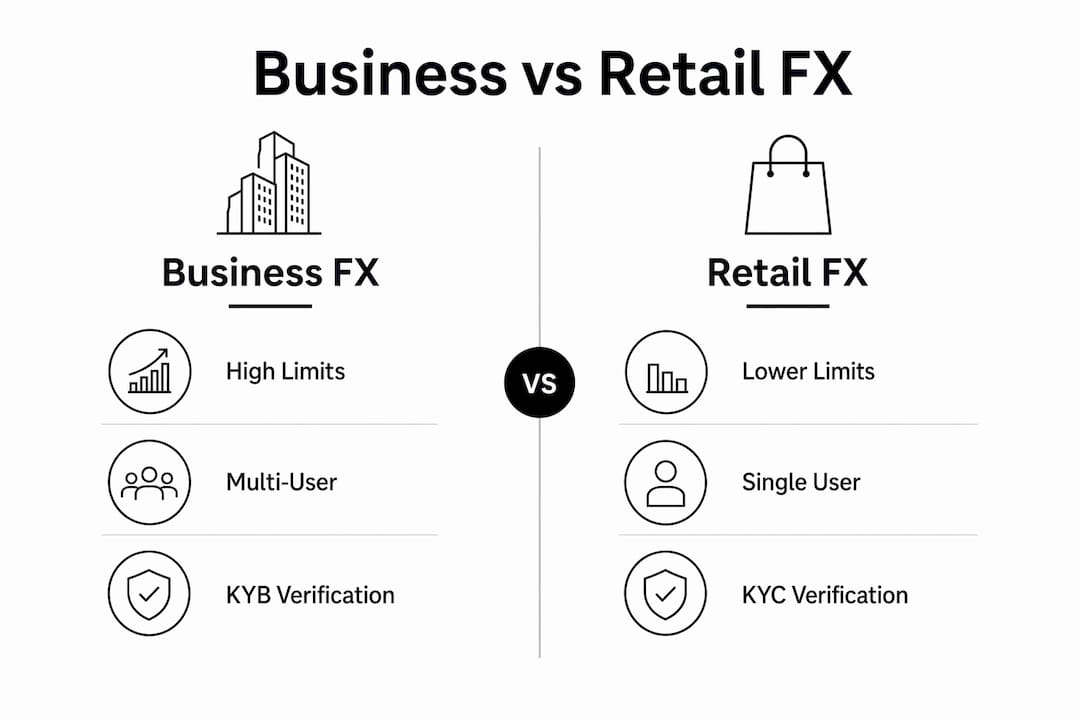
Business accounts differ from retail accounts in three fundamental ways: higher transaction limits, multi-user access, and deeper integration with corporate payment workflows. A retail account simply cannot support a company processing hundreds of international invoices per month. The transaction caps alone make retail accounts unworkable at scale.
The compliance gap is equally significant. Business accounts require Know Your Business (KYB) verification, which means submitting corporate registration documents, beneficial ownership structures, and proof of business activity. This is more rigorous than the Know Your Customer (KYC) process for personal accounts, and for good reason. Corporate accounts move larger sums and carry greater regulatory scrutiny.
For trading businesses specifically, the multi-user access feature is non-negotiable. A finance team needs different permission levels: a CFO approving large transfers, an accounts payable clerk initiating batch payments, and an auditor viewing transaction history without the ability to move funds. Retail accounts offer none of this structure.
What regulatory and compliance considerations apply to business FX accounts?
Regulated forex brokers and trading entities face the most demanding compliance requirements of any business FX account user. Corporate accounts for forex brokers must comply with frameworks including MiFID II in the EU, FCA regulations in the UK, and CySEC requirements in Cyprus. These are not optional standards. They define how client funds are held, how transactions are reported, and what documentation providers must maintain.
Key compliance requirements for trading businesses include:
- Segregated client accounts that keep client funds separate from operational funds, a legal requirement under MiFID II
- AML policies with transaction monitoring, suspicious activity reporting, and source-of-funds documentation
- KYB verification covering corporate structure, beneficial ownership, and regulatory licenses
- Annual transaction volume thresholds that some providers set at $10 million or more before offering full corporate FX services
- Jurisdictional choices between onshore EU/UK accounts and offshore options in jurisdictions like the British Virgin Islands, Cayman Islands, or Mauritius
The jurisdictional decision carries real operational and tax implications. Onshore EU or UK accounts offer the strongest regulatory credibility and are required for businesses serving retail clients in those markets. Offshore jurisdictions can offer greater operational flexibility and cost efficiency, but they require careful legal structuring to remain compliant with home-country regulations.
High-volume corporate FX accounts require detailed documentation and valid regulatory licenses during onboarding, which is why the process takes significantly longer than opening a retail bank account. Providers like Finxsol offer multi-currency IBANs, API connectivity, and compliance support across both onshore and offshore jurisdictions, which is particularly useful for brokers operating in multiple regulatory environments.
Pro Tip: Before approaching a provider, prepare a complete compliance package: corporate registration, beneficial ownership structure, AML policy documentation, and your regulatory license if applicable. Incomplete submissions are the single biggest cause of onboarding delays.
How to open and manage a business FX account effectively
Opening a business FX account is a structured process, not a quick sign-up. Onboarding typically takes 4 to 8 weeks with traditional institutions due to the depth of KYB and AML checks required. Fintech platforms with pre-built compliance infrastructure can reduce this timeline, but the documentation requirements remain the same.
Follow these steps to open and manage your account effectively:
- Prepare your documentation. Gather corporate registration certificates, beneficial ownership declarations, recent bank statements, proof of business activity, and any regulatory licenses your business holds.
- Choose a provider familiar with your business model. A provider experienced with forex brokers or import/export companies will ask the right questions and process your application faster than a generalist bank.
- Confirm API connectivity. If you run automated payment workflows or need real-time settlement, verify that the provider offers API integration before committing to onboarding.
- Set up forward contracts immediately. Once your account is active, use forward contracts to hedge known future currency exposures. This is the most underutilized tool in business FX management.
- Assign user roles and permissions. Configure access levels for each team member from day one. Mixing approval and execution roles in a single user account creates both operational risk and compliance exposure.
- Monitor multi-currency cash flow weekly. Set up balance alerts and review your currency positions regularly. Letting a large balance sit in a depreciating currency for weeks is a preventable loss.
Pro Tip: When evaluating providers, ask specifically about their experience with your industry. A provider who has onboarded other forex brokers or trading companies will have pre-built compliance templates that cut weeks off your application timeline.
The practical management of a business FX account also requires discipline around batch payments. Rather than processing individual international transfers as they arise, consolidating payments into scheduled batch runs reduces transaction fees and gives your finance team cleaner reconciliation records. For companies paying 20 or more international vendors per month, this alone can produce measurable cost savings.
Key takeaways
A business FX account is the foundational tool for any trading business or international company that needs to manage multi-currency payments, control currency risk, and operate at corporate transaction volumes without the limitations of retail banking.
| Point | Details |
|---|---|
| Core purpose | Business FX accounts serve treasury management, not speculation, holding 12 to 50+ currencies in one platform. |
| Compliance requirements | KYB, AML checks, and regulatory licenses are mandatory; onboarding takes 4 to 8 weeks at traditional institutions. |
| Key differentiator from retail | Higher transaction limits, multi-user access, and API integration set business accounts apart from personal or retail FX accounts. |
| Risk management tool | Forward contracts lock in exchange rates for future payments and are the most underutilized feature in business FX management. |
| Provider selection | Choose providers with direct experience in your industry to reduce onboarding time and avoid compliance gaps. |
Why most trading businesses underestimate their FX exposure
After working with international businesses across fintech, import/export, and digital services, the pattern I see most often is this: companies treat FX as a back-office problem until it becomes a front-office crisis. A trading business that operates on 15% margins can watch half of that disappear in a single quarter if it holds large USD receivables while the dollar weakens against its home currency. That is not a trading loss. It is a treasury management failure.
The businesses that handle this well do not necessarily use the most sophisticated platforms. They use the right tools consistently. Forward contracts are the clearest example. Every provider offers them. Most businesses never activate them because setting up the first contract feels like extra work. Then a currency moves 8% in six weeks and the conversation changes fast.
I have also seen companies choose providers based on brand recognition rather than fit. A major bank's FX desk is not built for a 12-person trading company processing $2 million per month in international payments. The relationship manager assigned to that account will not know your business model, and the fee structure will not reflect your volume. Specialist providers, including platforms built specifically for high-volume international businesses, offer better pricing, faster onboarding, and support staff who understand what a segregated client account actually means.
The fintech shift in this space is real. Platforms that combine compliance infrastructure with API-first architecture are compressing onboarding timelines and reducing the operational overhead of managing multi-currency accounts. That is a structural improvement for trading businesses, not a marketing claim.
— Ahmed
How Sigmaplatinum supports international traders and businesses
Sigmaplatinum is a B2B fintech platform built for international businesses that need efficient, compliant multi-currency payment workflows without the friction of traditional banking. The platform connects businesses to regulated business payment accounts designed for high-volume cross-border transactions, FX management, and corporate payment operations.
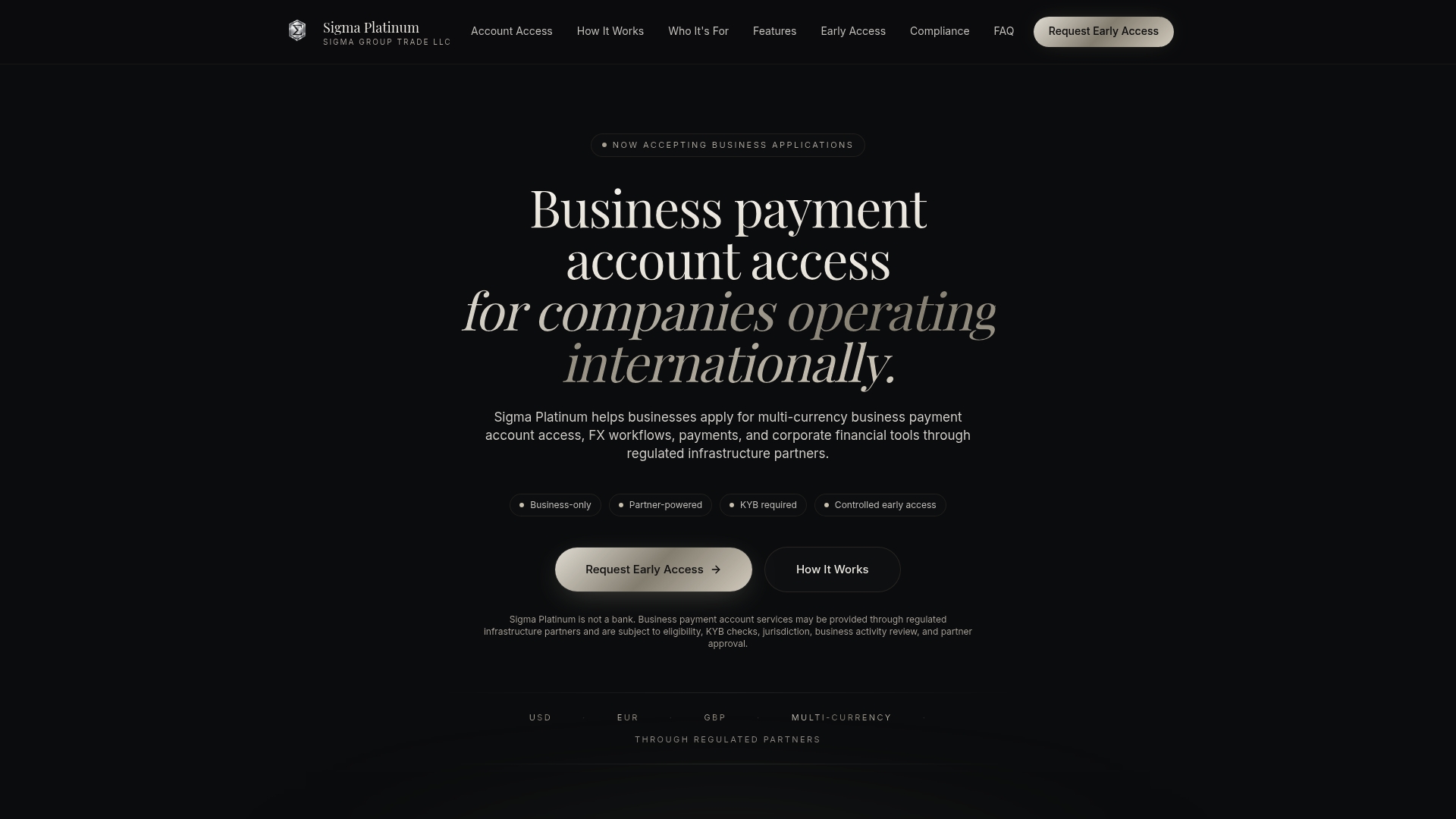
For traders and business owners managing international payments, Sigmaplatinum offers access to multi-currency accounts through regulated partners, with a compliance-focused onboarding process that includes rigorous KYB checks. The no-code model means your team gets access to essential payment infrastructure quickly, without building custom integrations from scratch. Digital agencies, consulting firms, and import/export companies already use Sigmaplatinum to manage their cross-border financial operations at scale. If you are ready to move beyond the limitations of retail banking, explore what Sigmaplatinum's payment accounts can do for your business.
FAQ
What is a business FX account used for?
A business FX account is used for holding, sending, and receiving multiple currencies in one platform, primarily for corporate treasury functions like paying international suppliers, collecting foreign revenue, and hedging currency risk. It is not designed for speculative forex trading.
How long does it take to open a business FX account?
Onboarding typically takes 4 to 8 weeks at traditional institutions due to KYB and AML verification requirements. Fintech platforms with pre-built compliance infrastructure can reduce this timeline for businesses with complete documentation.
What documents are needed to open a business FX account?
Most providers require corporate registration certificates, beneficial ownership declarations, recent bank statements, proof of business activity, and any applicable regulatory licenses. Regulated forex brokers must also provide evidence of client fund segregation policies.
How does a business FX account reduce currency risk?
Business FX accounts offer forward contracts that lock in exchange rates for future payments, protecting margins from market volatility. Neglecting forward contracts leaves companies exposed to currency fluctuations that can erode profitability on international transactions.
Can small businesses use a business FX account?
Yes. While some providers set minimum annual transaction thresholds, many platforms including those accessible through DavinciPay and similar fintech solutions offer business FX account access for smaller companies managing international payments, with fee structures scaled to lower transaction volumes.