
International payment accounts are specialized business accounts designed to hold, send, and receive funds across multiple currencies and jurisdictions, making them the operational backbone of any company scaling beyond its home market. Understanding how international payment accounts support growth is not optional for business leaders today. International payment volumes now exceed $190 trillion annually, and legacy banking infrastructure was never built to handle that scale. Platforms like Sigmaplatinum, along with SEPA-compliant payment service providers, have stepped in to fill the gap with dedicated IBANs, multi-currency wallets, and real-time FX tools.
How do international payment accounts support growth?
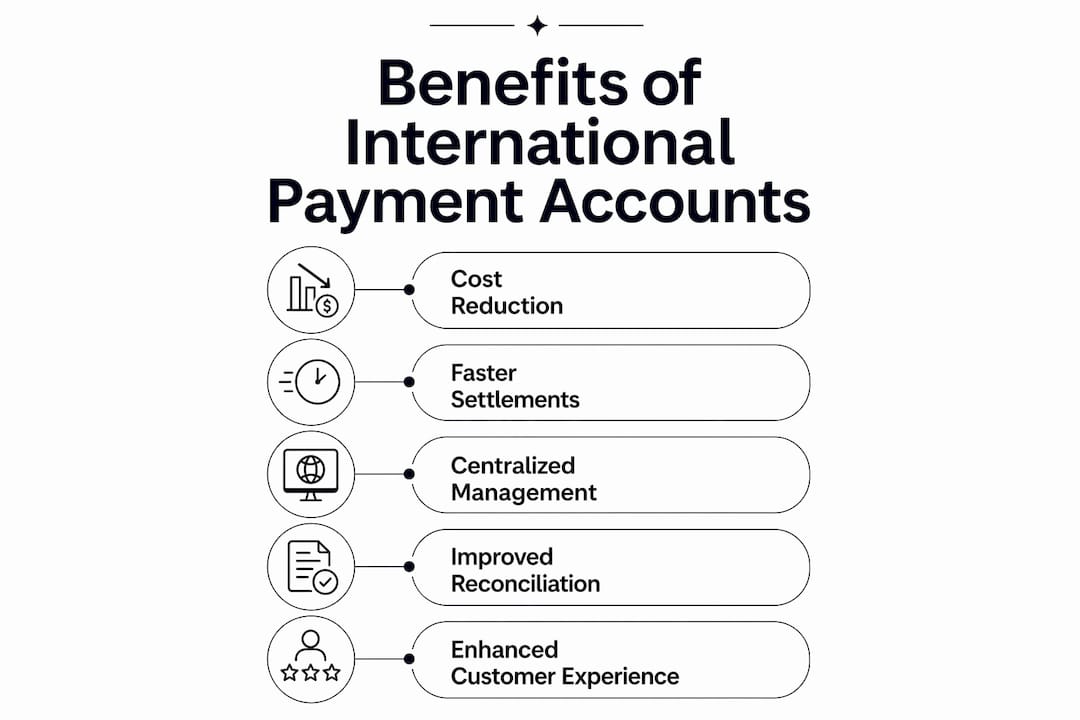
International payment accounts reduce the friction that kills cross-border deals before they close. When a business can receive euros, British pounds, and US dollars into a single account structure, it removes the delay and cost of routing funds through multiple correspondent banks.
The EU Instant Payments Regulation (IPR) is the clearest regulatory signal of where this market is heading. The IPR mandates 24/7 instant payment capabilities and fee parity for euro-area payment service providers, with deadlines set for receiving SCT Inst by january 2025 and sending with pricing parity by october 2025. That shift turns instant payments from a premium add-on into a baseline expectation. Businesses that already hold international payment accounts are positioned to benefit immediately.
The operational gains are concrete:
- Settlement speed: Funds arrive in seconds rather than 1–3 business days, improving cash flow predictability.
- Cost reduction: Fee parity rules eliminate the surcharge that previously made instant transfers more expensive than standard ones.
- Reconciliation: Dedicated IBANs per currency or per client make matching incoming payments to invoices far simpler.
- Finance workload: Automated transaction matching cuts the manual effort your finance team spends chasing remittance data.
Instant credit transfers accounted for 23% of total credit transfer volume in the euro area in H1 2025, across roughly 55.7 billion transactions and €26.2 trillion in total value. That share will grow as IPR compliance becomes universal. Businesses without instant-capable accounts will simply be slower than their competitors.
Pro Tip: Set up dedicated virtual IBANs for each major client or currency corridor. This makes reconciliation automatic and removes the need for manual reference matching entirely.
What are the key benefits of multi-currency management?
Multi-currency management is the practice of holding balances in multiple currencies within a single account structure, rather than converting every incoming payment to your home currency immediately. The benefits compound quickly for any business with international clients or suppliers.
- Reduced conversion costs. Every forced currency conversion carries a spread. Holding euros to pay a European supplier directly eliminates that cost entirely.
- Better cash flow visibility. When you can see your USD, GBP, and EUR balances in one dashboard, forecasting becomes accurate rather than approximate.
- Faster supplier payments. Paying from a held currency balance is instant. Paying via a conversion adds processing time and unpredictable FX rates.
- Lower exposure to rate volatility. Holding a currency you regularly spend in acts as a natural hedge against short-term rate swings.
Multi-currency accounts improve transaction visibility and reduce delays caused by intermediary banks, according to Accountancy Today. That visibility is not just convenient. It directly affects your ability to quote accurate prices to international clients and commit to payment terms with confidence.
Consider a consulting firm billing clients in the US, Germany, and the UAE. Without a multi-currency account, every invoice payment triggers a conversion, a fee, and a reconciliation entry. With a multi-currency account setup, the same firm holds USD, EUR, and AED balances, pays its own international contractors directly, and converts only what it needs for domestic expenses. The finance team spends less time on FX admin and more time on actual financial planning.

Pro Tip: Review your top five currency corridors quarterly. If you consistently receive or pay in a currency, holding a balance in that currency is almost always cheaper than converting on every transaction.
How does payment infrastructure affect growth outcomes?
Payment infrastructure choices directly determine margin, customer retention, and market-entry speed for companies scaling globally. This is not a back-office concern. It is a commercial one.
Smart routing is the clearest example. Smart routing directs each transaction through the lowest-cost, highest-success-rate path available at the moment of payment. The results are measurable. Smart payment routing can cut debit costs by up to 26%, save $18 per cross-border credit card transaction, and lift average order value by up to 46% when locally relevant payment methods are added. Those are not marginal improvements. They are the difference between a payment operation that drains margin and one that generates it.
The table below shows how different payment infrastructure choices affect key business outcomes:
| Infrastructure feature | Business impact |
|---|---|
| Smart routing | Reduces decline rates and per-transaction costs |
| Local payment methods | Increases conversion and average order value |
| Real-time FX pricing | Removes rate uncertainty at checkout |
| Dedicated IBANs | Automates reconciliation and reduces finance errors |
| Instant payment capability | Accelerates cash flow and supplier relationships |
Payment infrastructure is now integral to margin and retention for scaling global companies. The businesses that treat their payment account setup as a growth tool, rather than a utility, consistently outperform those that treat it as a cost center.
Adding locally relevant payment methods is a specific tactic worth calling out. A European buyer who prefers SEPA Direct Debit, a Brazilian buyer who uses Pix, and a US buyer who expects ACH are all more likely to complete a purchase when their preferred method is available. International payment accounts that support multiple local rails give businesses a direct conversion advantage.
What operational challenges do international payment accounts solve?
Fragmented banking is the most common operational problem for internationally active businesses. A company with accounts at five different banks, in three different countries, faces a reconciliation challenge that grows with every new transaction.
The core pain points are predictable:
- Inconsistent remittance data. When reference numbers and payment descriptions vary by bank or country, matching payments to invoices becomes a manual, error-prone task. Reconciliation complexity breaks international growth plans when remittance data is inconsistent across accounts.
- Multiple intermediary banks. Each intermediary in a payment chain adds a fee and a delay. A wire from the US to Southeast Asia can pass through three correspondent banks before arriving, with deductions at each step.
- Compliance gaps. Sanctions screening, KYB requirements, and AML checks vary by jurisdiction. A business without a compliance-ready account structure risks payment delays or account freezes at the worst possible moment.
- Manual finance workload. Finance teams at growing companies spend disproportionate time on payment chasing, FX reconciliation, and bank statement matching when accounts are fragmented.
Consolidated international payment accounts solve these problems by design. A single account structure with dedicated IBANs, built-in compliance screening, and multi-currency balances replaces the fragmented setup entirely. Once instant payments and fee parity are widely available, the competitive focus shifts entirely to compliance readiness and orchestration capability. Businesses that have already built that infrastructure are ahead.
The cross-border payment solutions that perform best in 2026 are those built on regulated, compliance-first account structures with real-time visibility across all currency positions.
Key Takeaways
International payment accounts support business growth by reducing transaction costs, accelerating settlement, centralizing multi-currency management, and replacing fragmented banking with compliance-ready infrastructure.
| Point | Details |
|---|---|
| Instant payments are now baseline | EU IPR mandates 24/7 instant transfers with fee parity, making speed a standard expectation. |
| Multi-currency accounts cut costs | Holding currency balances eliminates forced conversions and reduces FX fees on recurring corridors. |
| Smart routing improves margins | Routing optimization can reduce debit costs by up to 26% and lift order values by up to 46%. |
| Reconciliation drives growth readiness | Consistent remittance data and dedicated IBANs prevent the reconciliation failures that stall scaling. |
| Compliance infrastructure is non-negotiable | Sanctions screening and KYB readiness prevent account freezes that disrupt cash flow at critical moments. |
Why I stopped treating payments as an afterthought
Most business leaders I speak with treat their payment account setup as something to fix later. They prioritize product, sales, and hiring. Payments come last. That is a mistake I have seen cost companies real money, and real growth.
The businesses that scale internationally fastest are the ones that treat payment infrastructure as a growth lever from day one. They set up multi-currency accounts before they need them. They configure dedicated IBANs before reconciliation becomes a problem. They check compliance requirements before entering a new market, not after a payment gets frozen.
The reconciliation issue is the one that surprises people most. A fragmented account setup feels manageable when you have 20 transactions a month. At 200 transactions, it becomes a full-time job. At 2,000, it breaks. The businesses that get ahead of this by consolidating their accounts early save weeks of finance team time every quarter.
My honest recommendation: treat your payment account structure the same way you treat your legal entity structure. Get it right early. The cost of fixing it later, in lost time, frozen payments, and missed FX savings, is always higher than the cost of doing it properly at the start. For non-EU firms specifically, understanding account eligibility requirements before applying saves significant time and avoids onboarding delays.
— Ahmed
Sigmaplatinum: purpose-built for international payment account access
Sigmaplatinum is a B2B fintech platform built specifically for international businesses that need efficient, compliant payment account access without the friction of traditional banking.
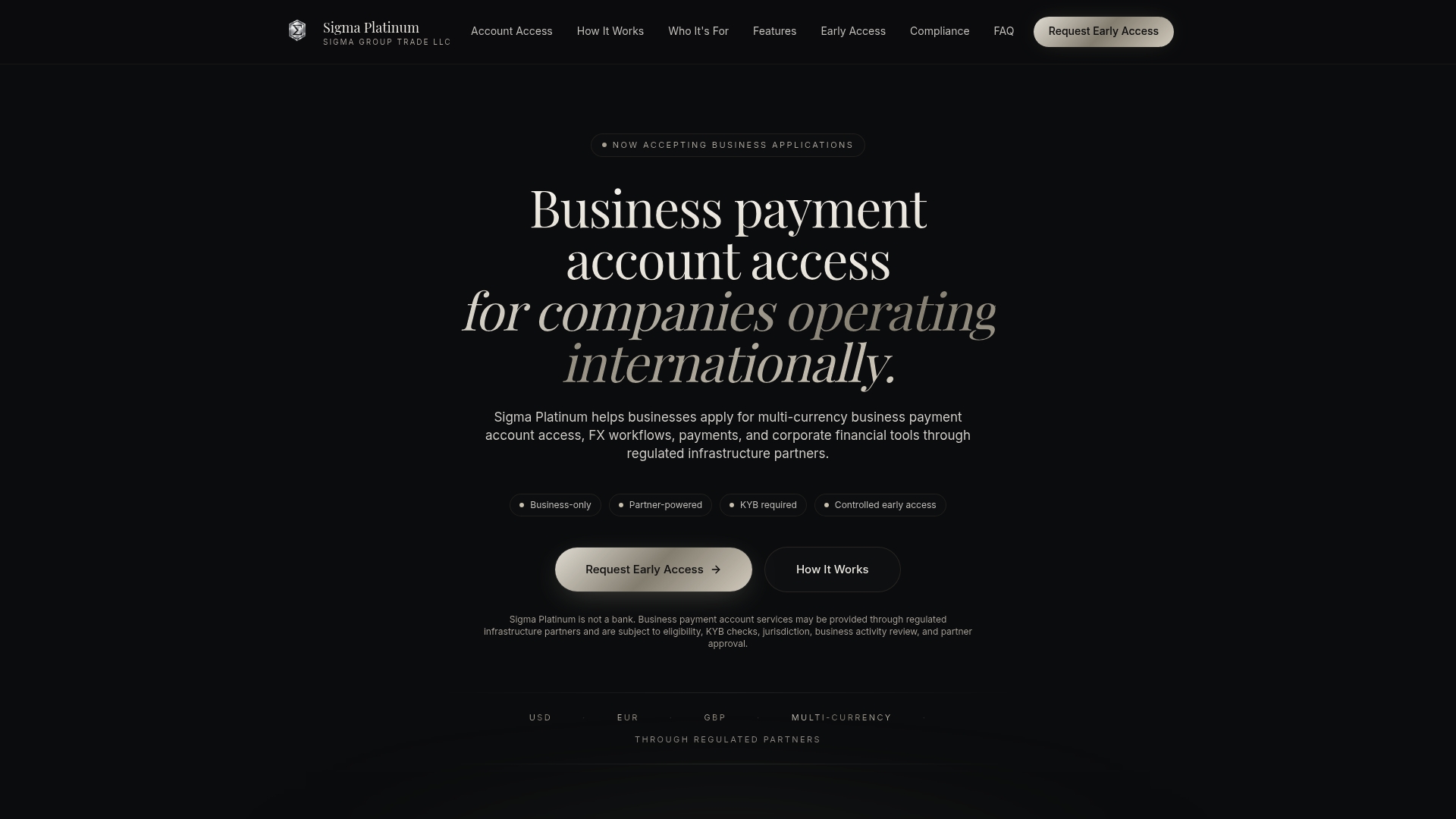
The platform gives digital agencies, consulting firms, and import/export companies access to multi-currency accounts, FX workflows, and corporate financial tools through regulated partners. Onboarding includes rigorous KYB checks and partner evaluations, so accounts are built on a compliance-ready foundation from the start. Sigmaplatinum operates on a no-code model, meaning businesses get access to the tools they need without technical integration work. For companies ready to move beyond fragmented banking and build a payment structure that supports real growth, Sigmaplatinum's business payment accounts are the practical starting point.
FAQ
What are international payment accounts?
International payment accounts are business accounts that hold, send, and receive funds across multiple currencies and jurisdictions. They typically include dedicated IBANs, multi-currency balances, and built-in compliance tools.
How do international payment accounts reduce costs?
They eliminate forced currency conversions, reduce intermediary bank fees, and enable smart routing that can cut debit costs by up to 26% per transaction.
What is the EU Instant Payments Regulation?
The EU IPR requires euro-area payment service providers to offer 24/7 instant credit transfers at no extra cost, with full compliance deadlines set across 2025. It makes instant payments a standard service rather than a premium one.
Why does reconciliation matter for international growth?
Inconsistent remittance data across fragmented accounts creates manual finance work that scales badly. Dedicated IBANs and consolidated account structures make payment matching automatic and accurate.
How does Sigmaplatinum support international businesses?
Sigmaplatinum provides access to multi-currency business payment accounts through regulated partners, with compliance-focused onboarding and no-code account access designed for international companies scaling across borders.