
A business account for non-EU firms is a corporate financial account that enables companies registered outside the European Union to manage payments, hold multiple currencies, and meet regulatory compliance requirements for operating within and beyond the EU. These accounts differ from standard domestic accounts because they require additional documentation, economic substance proof, and compliance with anti-money laundering (AML) frameworks. Providers range from traditional EU banks like Deutsche Bank and Raiffeisen to fintech platforms and Electronic Money Institutions (EMIs) such as Revolut Business and Wise Business. For any non-EU company conducting cross-border transactions, holding a dedicated corporate account is not optional. It is the financial infrastructure that makes international operations viable.
What is a business account for non-EU firms?
A business account for non-EU firms is a regulated corporate account that separates business finances from personal funds, provides access to SEPA payment networks, and supports multi-currency management for companies operating internationally. The industry standard term for this product is an international corporate account or non-resident business account, depending on the jurisdiction and provider. Both terms describe the same core function: giving foreign-registered companies a legitimate financial home inside or connected to the EU financial system.
The practical value is significant. An EU business bank account provides SEPA payment access, cleaner separation of business finances, and multi-currency management benefits that reduce friction in daily operations. For a consulting firm in Singapore billing clients in Germany, or an import/export company in the UAE paying suppliers in Poland, this account type is the operational backbone. Without it, every transaction carries higher fees, longer settlement times, and greater counterparty friction.

Non-resident business accounts are not a niche product. They are a recognized category across EU banking regulation, EMI licensing frameworks, and fintech compliance structures. Understanding what they require, and what they offer, is the starting point for any non-EU company building a serious international presence.
What documentation and compliance requirements do non-EU firms face?
The documentation requirements for opening a non-EU company bank account are more demanding than most business owners expect. Banks and EMIs conduct Know Your Customer (KYC) and Know Your Business (KYB) checks that go well beyond collecting a passport and incorporation certificate.
Standard documents required across most providers include:
- Certificate of incorporation and articles of association from the company's home jurisdiction
- Passports and proof of address for all directors and Ultimate Beneficial Owners (UBOs) holding more than 25% ownership
- UBO declaration forms confirming ownership structure and control
- Business plan describing revenue model, target markets, and expected transaction volumes
- Bank statements from existing accounts (typically 3 to 6 months)
- Proof of contracts or client relationships demonstrating real commercial activity
The compliance layer goes deeper than paperwork. Banks demand proof of economic substance, including operational activity, local contractors, and a transparent business model. A company that exists only on paper, with no contracts, no clients, and no clear revenue flow, will be rejected regardless of how clean its incorporation documents are.
Corporate banking compliance is also tied directly to tax compliance. Meeting AML regulations fully is not just a formality. It is the condition under which accounts remain open and unfrozen. Non-EU firms with complex ownership structures, nominee directors, or unclear fund flows face enhanced due diligence (EDD) reviews that can extend processing times significantly.
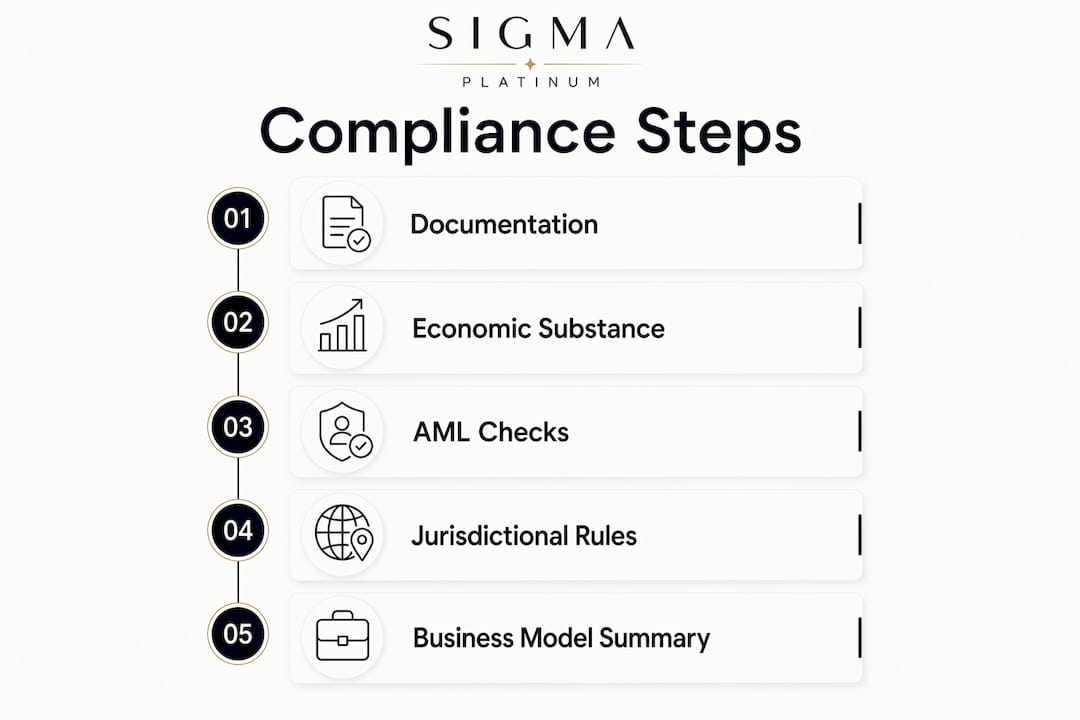
Pro Tip: Prepare a one-page business model summary in plain language before applying. Banks focus less on documentation volume and more on transparent business model communication to manage their risk perception. A clear narrative about who pays you, why, and how funds move through your account reduces back-and-forth requests dramatically.
Requirements also vary by jurisdiction. Opening a corporate account in Germany through a traditional bank is a different process from opening one through an Estonian EMI or a Lithuanian fintech. Each jurisdiction applies its own regulatory overlay on top of the EU's baseline AML directives.
How do fintech solutions compare to traditional banks for non-EU business accounts?
The gap between traditional banks and fintech providers for non-EU business accounts is wide, and it is widening further as EMI licensing expands across the EU.
| Feature | Traditional banks | Fintech / EMI providers |
|---|---|---|
| Onboarding process | In-person, branch visit often required | Fully remote, digital document upload |
| Account opening time | 4 to 8 weeks for most jurisdictions | 2 to 14 business days with most EMIs |
| Multi-currency IBANs | Limited, often single-currency | Standard feature across most platforms |
| FX fees | 1.5% to 3% on average | Often 0.3% to 1% with mid-market rates |
| Rejection risk | High, especially for non-EU firms | Lower, but still present for high-risk sectors |
| Regulatory protection | Full deposit insurance (up to €100,000 via EDIS) | Safeguarded funds, not deposit-insured |
Modern fintech and EMIs enable fully online opening of multi-currency accounts with local IBANs, bypassing physical presence requirements entirely. For a non-EU company without a physical EU office, this is the most practical entry point into the European financial system. Revolut Business, Wise Business, and Airwallex each offer multi-currency IBANs with competitive FX rates and remote onboarding that takes days rather than months.
Traditional banks still offer advantages for companies that qualify. They provide full deposit insurance, access to credit facilities, and deeper integration with local payment infrastructure. For non-EU firms with established EU subsidiaries, significant transaction volumes, and clean compliance histories, a traditional bank relationship adds credibility with suppliers and clients.
The risk with fintech providers is scope. EMIs cannot offer loans, overdrafts, or investment products. Their accounts are payment accounts, not full banking relationships. For a company that needs only to send and receive international payments and manage currencies, this is sufficient. For a company building long-term EU operations, a traditional bank relationship remains the goal, with a fintech account as the practical starting point.
Pro Tip: Specialized banks aligned with your business type reduce friction significantly. An import/export company will find better service at a trade-focused bank or a fintech built for high-volume cross-border payments than at a retail bank that treats international business as an edge case.
What challenges do non-EU firms commonly encounter?
The rejection rate for non-EU companies applying for corporate accounts is not a minor inconvenience. Over 60% of international companies face rejection on their first attempt due to strict compliance and regulatory requirements. That statistic means the majority of non-EU firms applying for business banking options will need to reapply, revise their documentation, or change their target provider.
The most common reasons for rejection include:
- Insufficient economic substance. Virtual offices alone are often insufficient as proof of presence. Banks require real business activity evidence such as contracts, invoices, or local partners.
- Incomplete or inconsistent documentation. A mismatch between the business plan and the stated transaction profile triggers immediate scrutiny.
- Industry de-risking. Over 40% of traditional European banks automatically de-risk certain industries, rejecting applications from non-EU firms in sectors like crypto, adult content, gambling, or high-volume cash businesses without in-depth analysis.
- Complex ownership structures. Multi-layer holding companies, nominee arrangements, or UBOs in high-risk jurisdictions extend processing and increase rejection probability.
- Unclear fund flows. Banks need to understand where money comes from and where it goes. Vague answers about revenue sources are treated as red flags.
Processing time compounds the challenge. Bank risk scoring depends heavily on industry and transaction profile. Companies with complex outbound payments or layered ownership face multi-week delays even when their applications are ultimately approved.
The strategies that improve success rates are straightforward but require preparation. Work with a specialized advisor or compliance consultant before applying. Target providers that have a documented track record with your business type. Prepare contracts, client letters, and financial projections before the first document request arrives. And if a traditional bank rejects your application, treat it as feedback rather than a final answer. An EMI or specialized fintech may approve the same company within days.
How can non-EU companies optimize use of business accounts for international payments?
Opening the account is step one. Using it to reduce costs and improve payment efficiency is where the real value is captured.
-
Use multi-currency IBANs to eliminate conversion costs. Holding balances in EUR, USD, GBP, and other currencies means you pay suppliers and receive clients in their local currency without triggering FX conversion on every transaction. For importers managing multi-currency payments, this alone can reduce annual FX costs by several percentage points of revenue.
-
Hedge FX exposure on large or recurring transactions. Most fintech platforms and specialist FX providers offer forward contracts and rate alerts. Locking in a rate for a known future payment protects margins when currency markets move against you.
-
Integrate corporate cards with expense management tools. Platforms like Pleo, Spendesk, or the native card features in Revolut Business allow you to issue virtual and physical cards to team members with spending limits and real-time transaction visibility. This replaces manual expense reporting with automated categorization.
-
Connect your account to your ERP or accounting software. QuickBooks, Xero, and NetSuite all offer direct integrations with major fintech business accounts. Automated reconciliation reduces bookkeeping time and improves the accuracy of financial reporting.
-
Use local payment rails where available. A UK GBP IBAN enables Faster Payments. A US account enables ACH. Paying through local rails instead of SWIFT wire transfers cuts fees and settlement times from days to hours.
| Optimization | Estimated benefit |
|---|---|
| Multi-currency IBAN usage | Eliminates conversion fees on matched currency flows |
| Forward FX contracts | Locks in rates, protects margins on large payments |
| Corporate card automation | Reduces expense processing time by up to 70% |
| ERP integration | Cuts reconciliation errors and manual bookkeeping hours |
For agencies managing international client payments, a structured multi-currency payment setup is the difference between a profitable cross-border operation and one that leaks margin on every transaction.
Key takeaways
A business account for non-EU firms requires economic substance, thorough documentation, and a provider matched to your business profile. Fintech EMIs offer the fastest path to access, while traditional banks offer deeper services for established operations.
| Point | Details |
|---|---|
| Definition matters | A non-EU business account is a regulated corporate account enabling international payments and multi-currency management. |
| Documentation depth | Banks require UBO declarations, business plans, and proof of real commercial activity, not just incorporation papers. |
| Rejection is common | Over 60% of non-EU firms are rejected on first application. Preparation and provider selection are critical. |
| Fintech vs. traditional banks | EMIs offer remote onboarding in days; traditional banks offer credit and full deposit insurance but take weeks. |
| Optimization drives ROI | Multi-currency IBANs, FX hedging, and ERP integration reduce costs and improve payment efficiency significantly. |
Why the conventional wisdom on international business banking is wrong
Most advice for non-EU firms opening business accounts focuses almost entirely on documentation. Get the right papers, submit them correctly, and you will be approved. That framing misses the actual problem.
I have seen well-prepared companies with perfect documentation get rejected by three consecutive banks, while a less polished application from a company with strong client contracts and clear revenue flows sailed through in two weeks. The documentation is the floor, not the ceiling. What banks are actually evaluating is risk narrative. They want to understand your business well enough to defend the account relationship to their compliance team.
The shift from traditional banking to fintech-driven solutions is real, but it is not a replacement for understanding what banks need. EMIs are more accessible, but they are also more limited. A company that builds its entire financial infrastructure on a single fintech account is exposed if that provider loses its license, changes its terms, or exits a market. The smart approach is layered: an EMI account for day-to-day international payments, and a traditional bank relationship as the long-term goal.
Economic substance requirements are also getting stricter, not looser. Regulators across the EU are pushing banks to document not just who their clients are, but what those clients actually do. Non-EU firms that treat substance as a checkbox will find themselves re-verified every 12 to 18 months with increasingly detailed requests. Building real operational presence, even if modest, is the only durable answer.
Technology is reshaping international business banking, making onboarding more accessible than ever. But accessibility does not mean simplicity. The firms that succeed are the ones that treat banking as a strategic relationship, not an administrative task.
— Ahmed
How Sigmaplatinum helps non-EU firms access business payment accounts
Non-EU companies navigating the requirements for international business accounts need more than a checklist. They need a platform built for their specific situation.
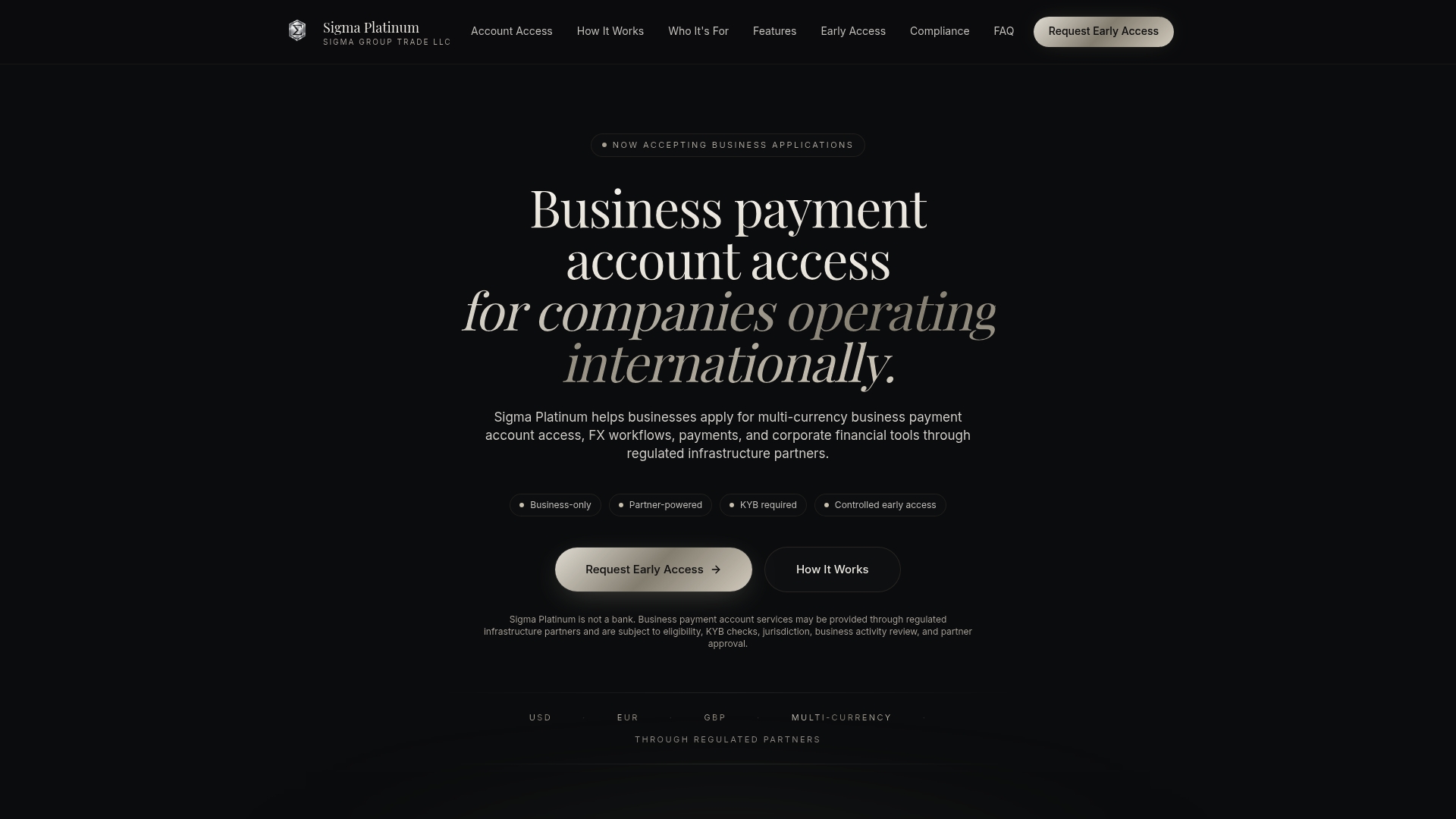
Sigmaplatinum is a B2B fintech platform designed specifically for international businesses seeking efficient payment workflows. The platform connects non-EU firms with regulated partners that support multi-currency accounts, FX management, and corporate financial tools through a compliance-focused onboarding process that includes rigorous KYB checks. Digital agencies, consulting firms, and import/export companies use Sigmaplatinum to access business payment account solutions without the complexity of managing multiple bank relationships independently. For high-volume cross-border businesses that need a reliable, compliant financial infrastructure, Sigmaplatinum provides the access and support to get there faster.
FAQ
What is a non-EU business account?
A non-EU business account is a corporate financial account held by a company registered outside the European Union, used to manage international payments, hold multiple currencies, and comply with EU banking regulations. It is also called a non-resident corporate account or international business account.
How long does it take to open a corporate account abroad?
Account opening takes 2 to 14 business days with fintech providers and EMIs, but 4 to 8 weeks with traditional banks that require physical presence and extended compliance reviews.
Why do non-EU firms get rejected for business accounts?
The most common reasons are insufficient economic substance, incomplete documentation, and automatic de-risking by banks in certain industries. Over 60% of international companies are rejected on their first application.
What documents are required for international business accounts?
Standard requirements include a certificate of incorporation, passports and proof of address for all UBOs, a UBO declaration, a business plan, recent bank statements, and evidence of real commercial activity such as contracts or invoices.
Are fintech accounts safe for non-EU business banking?
Fintech EMI accounts use safeguarded client funds held separately from the provider's own capital, which protects balances if the provider becomes insolvent. They do not carry the same deposit insurance as traditional banks, but regulated EMIs operating under EU licensing frameworks provide strong structural protection for business funds.