
A multi-currency account eligibility checklist is the structured set of documentation, compliance, and business verification criteria a company must satisfy before a bank or fintech provider activates an account capable of holding and transacting in multiple currencies. For business owners running cross-border operations, getting this checklist right is the difference between a fast approval and weeks of back-and-forth with compliance teams. Providers like Wise and Airwallex each apply their own version of this checklist, but the underlying requirements share a common framework rooted in Know Your Business (KYB) standards and anti-money laundering (AML) regulations.
1. Core business documentation requirements
The foundation of any multi-currency account eligibility check is your business formation paperwork. Account activation requires incorporation certificates, proof of business address, and government-issued identification for account controllers before any account goes live. These documents confirm your company's legal existence and physical presence, two facts every regulated provider must verify before onboarding.
The specific documents vary slightly by entity type. A corporation typically submits its certificate of incorporation, articles of association, and a recent utility bill or bank statement showing the registered address. A partnership submits a partnership agreement alongside the same address proof. Sole traders face a lighter load but still need government-issued ID and proof of trading address.
Common documents across all entity types include:
- Certificate of incorporation or business registration
- Memorandum and articles of association
- Proof of registered business address (utility bill or bank statement, dated within 90 days)
- Government-issued photo ID for all directors and authorized signatories
- Business bank statements (typically the last three to six months)
Pro Tip: Pre-assemble all documents into a single organized folder before starting any application. Providers often request multiple items simultaneously, and having everything ready cuts the average response time from days to hours.
2. Beneficial ownership and directorship verification

Beneficial ownership verification is the compliance step that trips up the most applicants. The FinCEN CDD Rule defines two prongs: the ownership prong, covering any individual holding 25% or more of equity, and the control prong, covering one executive with significant managerial authority regardless of equity stake. Both must be identified and verified before account approval.
For each beneficial owner and controlling person, providers collect a standard set of personal details:
- Full legal name
- Date of birth
- Residential address
- Social Security Number or government-issued taxpayer ID
- Copy of passport or national ID card
A 2026 update from FinCEN provides meaningful relief for businesses opening additional accounts with the same institution. The exceptive relief order limits full beneficial ownership re-verification to the initial account opening and specific risk triggers, reducing repetitive document submissions for established customers. This means if your company already holds an account with a provider, opening a second currency account under the same entity is faster.
Beneficial ownership compliance is less about company size and more about transparency. A two-person startup with a 50/50 split must document both owners just as thoroughly as a mid-market firm with a complex cap table.
Institutions may also rely on certified beneficial ownership declarations when supported by underlying documentation and ongoing risk-based due diligence, which gives compliance teams a practical shortcut without sacrificing regulatory rigor.
3. Business activity and risk profile information
Static documents only tell part of the story. Providers also assess your business operations and risk profile as part of the eligibility process. Banks evaluate customer risk profiles beyond paperwork, factoring in business description, expected transaction volumes, counterparty countries, and industry sector before making an approval decision.
This risk-based approach means two companies submitting identical documents can receive different treatment based on what they do and where they operate. An import/export company trading with high-risk jurisdictions will face enhanced due diligence. A digital agency billing clients in Western Europe and North America will typically move through faster.
Sanctions and AML screening run in parallel with document review. Entities with sanctioned owners or connections to restricted jurisdictions face automatic holds, regardless of how complete their documentation is. Many entrepreneurs underestimate how much this screening influences eligibility outcomes compared to paperwork alone.
Pro Tip: Write a clear, one-page source-of-funds narrative before you apply. Describe where your revenue comes from, who your major clients are, and why you need multi-currency functionality. Risk officers read hundreds of applications. A clear narrative answers their questions before they ask them and reduces the chance of a document re-request.
4. How eligibility criteria vary by provider and jurisdiction
Not all multi-currency banking options apply the same standards. Wise, Airwallex, and traditional banks like those in Cyprus each define eligibility differently based on their regulatory environment, risk appetite, and target customer profile.
Digital-first fintechs like Wise and Airwallex typically offer faster onboarding through automated KYC/KYB workflows, but they still require rigorous beneficial ownership verification. Traditional banks in jurisdictions like Cyprus operate under EU AML directives and apply more manual review processes, which increases thoroughness but extends timelines.
Processing times depend heavily on complexity and document completeness. A standard Cyprus bank application takes 7 to 10 business days, while cross-jurisdiction structures with complex ownership chains can take 3 to 4 weeks. Digital providers often approve straightforward applications within 24 to 72 hours.
| Provider / Jurisdiction | Typical processing time | Key eligibility factors | Best suited for |
|---|---|---|---|
| Wise (Business) | 1 to 3 business days | KYB documents, beneficial ownership, business description | Freelancers, SMEs, digital businesses |
| Airwallex | 2 to 5 business days | Incorporation docs, director ID, transaction volume estimates | E-commerce, SaaS, international agencies |
| Cyprus bank account | 7 to 10 days (standard) | Full KYB, source of funds, business plan | Holding companies, international traders |
| Cyprus (complex structure) | 3 to 4 weeks | Enhanced due diligence, multi-jurisdiction ownership | Cross-border groups, offshore entities |
Choosing the right provider starts with matching your business profile to their eligibility framework. A consulting firm with clean ownership and EU clients fits a digital fintech's profile well. A trading company with owners across multiple jurisdictions may find a traditional bank's thorough process more appropriate, even if it takes longer.
5. Common eligibility pitfalls and how to avoid them
The most frequent reason applications stall is incomplete or inconsistent documentation. Providers compare every submitted document against each other, and any mismatch, such as a director's name spelled differently across the incorporation certificate and their passport, triggers a manual review that adds days to the process.
The second most common pitfall is unclear beneficial ownership. When ownership structures involve holding companies or trusts, applicants must trace the chain all the way to the natural persons at the top. Submitting only the immediate corporate shareholder without disclosing the individuals behind it will result in a request for additional information or an outright rejection.
Use this readiness checklist before submitting any application:
- Confirm all director and owner names match exactly across every document
- Verify your certificate of incorporation is current and not expired or pending renewal
- Check that your proof of address is dated within the last 90 days
- Prepare a complete beneficial ownership chart showing all individuals with 25% or more equity
- Draft a business description that includes your industry, revenue model, and primary markets
- Gather at least three months of business bank statements showing consistent trading activity
- Confirm no sanctions exposure for any named owner or director using a public sanctions list
Digital KYB tools like Onfido and Jumio can pre-screen your documents for common errors before submission. Working with a compliance consultant is worth considering for complex ownership structures, particularly when multiple jurisdictions are involved.
Key takeaways
Meeting multi-currency account eligibility requires complete business documentation, transparent beneficial ownership disclosure, and a clear risk profile narrative submitted together from the start.
| Point | Details |
|---|---|
| Documentation is the foundation | Incorporation certificates, address proof, and director IDs must be current and consistent across all documents. |
| Beneficial ownership is non-negotiable | All individuals holding 25% or more equity plus one controlling executive must be identified and verified. |
| Risk profile shapes approval speed | Business description, transaction volumes, and counterparty countries directly influence how quickly providers approve applications. |
| Provider choice affects timeline | Digital fintechs approve in days; traditional banks in complex jurisdictions can take up to four weeks. |
| Preparation prevents delays | A source-of-funds narrative and pre-assembled document folder reduce back-and-forth with compliance teams significantly. |
What I've learned from watching businesses get this wrong
I've seen well-run companies with legitimate international operations get stuck in onboarding for six weeks because they underestimated one thing: beneficial ownership transparency. The paperwork was complete. The business was real. But the ownership structure ran through two holding companies in different jurisdictions, and no one had prepared a clear chart showing who actually owned what at the individual level. The provider kept asking follow-up questions because the application gave them no choice.
The businesses that move through eligibility fastest are not the simplest ones. They are the most prepared ones. A trading company with owners in three countries can get approved in ten days if the application arrives with a clean ownership chart, a source-of-funds explanation, and bank statements that match the described business activity. Complexity is not the enemy. Ambiguity is.
I also think too many entrepreneurs treat provider selection as an afterthought. They pick the most recognizable name and apply, then discover the provider's eligibility framework does not fit their business structure. Matching your company profile to the right provider before applying saves more time than any document shortcut. A digital agency with EU clients and a clean ownership structure belongs on a fintech platform. A holding company with cross-border subsidiaries belongs in a traditional banking relationship, even if the onboarding takes longer.
The 2026 FinCEN exceptive relief is genuinely good news for businesses that plan to grow their account relationships over time. Re-verification requirements are lighter for established customers, which means getting the first application right pays dividends every time you add a new currency account or product later.
— Ahmed
How Sigmaplatinum supports your multi-currency account application
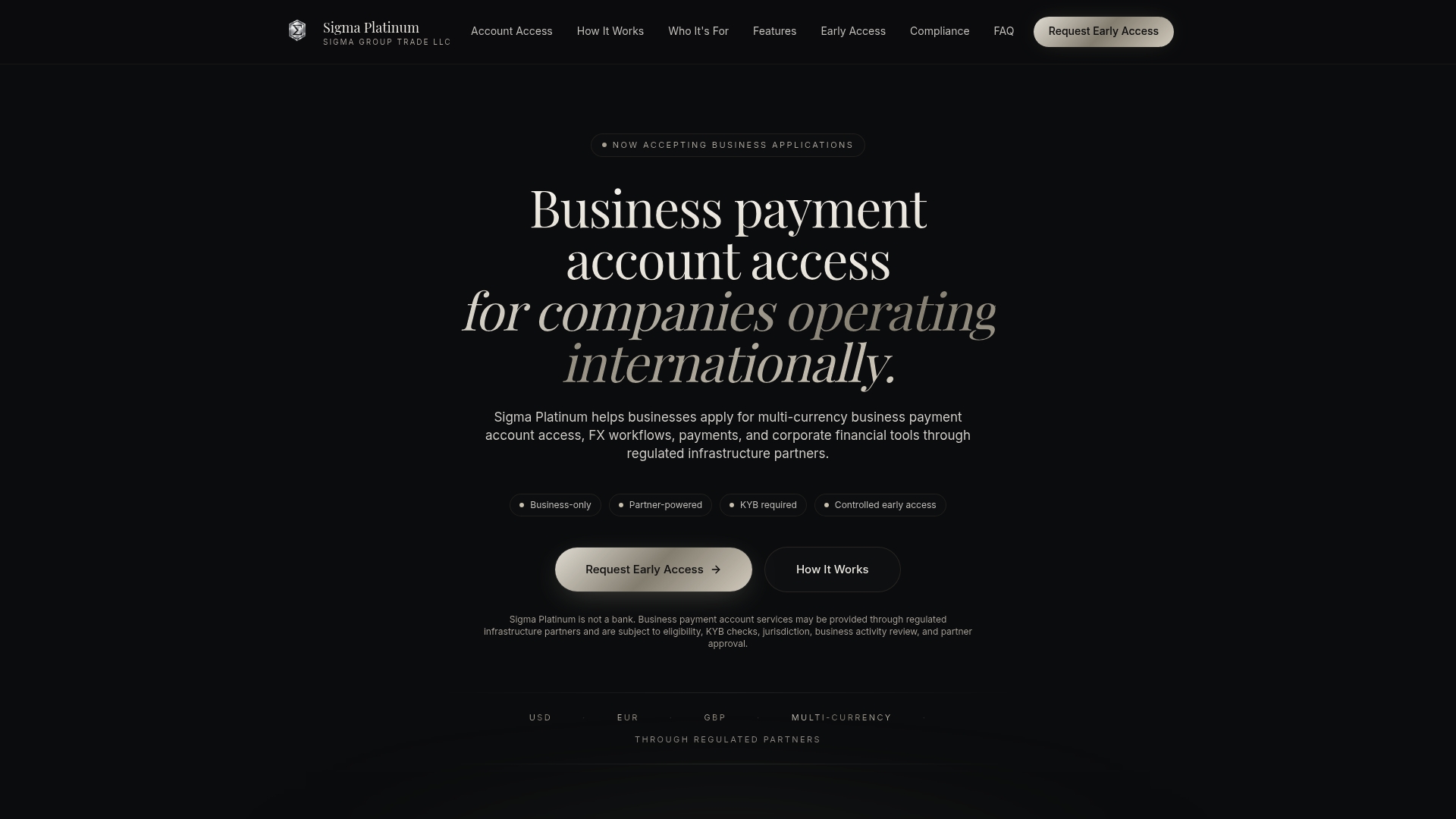
Sigmaplatinum is built specifically for international businesses that need multi-currency account access without the friction of traditional banking. The platform connects companies to regulated banking partners through a compliance-focused onboarding process that includes rigorous KYB checks, beneficial ownership verification support, and partner evaluations designed to match your business profile to the right account structure. Digital agencies, consulting firms, and import/export companies use Sigmaplatinum to manage FX workflows and cross-border payments through a single interface. If you are ready to apply with confidence, explore business payment account solutions at Sigmaplatinum and get matched to the right provider for your structure and transaction needs.
FAQ
What documents are required to open a multi-currency account?
Most providers require a certificate of incorporation, proof of business address, government-issued ID for all directors and beneficial owners, and a business description with expected transaction volumes. Document requirements vary slightly by provider and entity type.
Who qualifies as a beneficial owner for account eligibility?
A beneficial owner is any individual holding 25% or more of company equity, plus one person with significant executive control. The FinCEN CDD Rule applies this definition to U.S.-regulated accounts, and most international providers follow the same standard.
How long does it take to get approved for a multi-currency account?
Approval timelines range from one to three business days for digital fintechs to three to four weeks for complex structures at traditional banks. Processing time depends on document completeness and the complexity of your ownership structure.
Does my industry affect my eligibility for a multi-currency account?
Yes. Providers apply a risk-based screening process that factors in your industry sector, counterparty countries, and expected transaction volumes. High-risk industries or businesses trading with sanctioned jurisdictions face enhanced due diligence regardless of document quality.
Can I use the same documents for multiple accounts at the same provider?
Under the 2026 FinCEN exceptive relief, institutions can limit full beneficial ownership re-verification to the initial account opening rather than repeating it for every new account. This makes opening additional currency accounts faster once your business is already onboarded.