
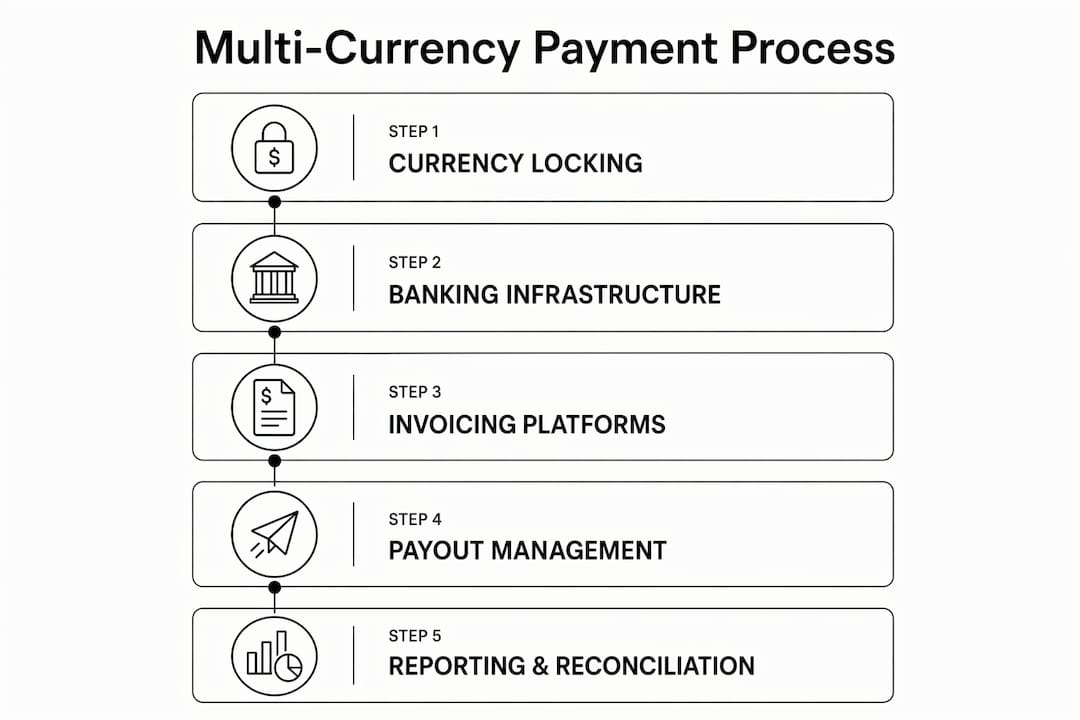
Agency multi-currency client payments are defined as the infrastructure, processes, and tools agencies use to invoice, collect, and reconcile client funds across GBP, EUR, USD, and other currencies without manual conversion steps at each transaction. Managing this well is not a back-office nicety. It is the difference between predictable revenue and a finance team drowning in FX adjustments every month. Platforms like Plutio now support 120+ currencies per invoice, while banking solutions built around virtual IBANs and multi-currency accounts have made it possible to hold and route GBP, EUR, and USD under one operational structure. The agencies that get this right lock their FX rates early, use dedicated account infrastructure, and automate reconciliation rather than patching it together manually.
How do currency locking strategies reduce exchange rate risk in agency billing?
Currency locking is the practice of fixing an FX rate at a defined point in the billing cycle, either at quote time, invoice time, or payment time, to protect the revenue margin from exchange rate movements. For agencies billing international clients in GBP, EUR, or USD, the gap between sending an invoice and receiving payment can span 30 to 60 days. A lot can happen to a currency pair in that window.
The most practical approach for most agencies is locking the rate at invoice time. A SaaS company billing a European client in EUR, for example, fixes the EUR/GBP rate the moment the invoice is issued. Whatever the rate does over the next 30 days is irrelevant. The agency knows exactly what it will receive in its base currency when the client pays.

Quote-time locking goes one step further. It protects the agency from the moment a proposal is accepted, which matters on large retainer agreements where the sales cycle itself can run several weeks. Payment-time locking, by contrast, accepts spot rates and works best for agencies with high transaction volumes and natural currency hedges across their client base.
Hybrid locking strategies are the most operationally efficient approach for mid-size agencies. Lock the rate for deals above a defined threshold, say $10,000 or £8,000, and accept spot rates for smaller project invoices where the FX exposure is minimal. This balances cost and predictability without over-engineering the process.
Pro Tip: Platforms like Stripe and Wise both offer forward contracts and rate-locking features that integrate directly with invoicing workflows. Set up automatic rate capture at invoice creation so your finance team never has to manually record an FX rate again.
Key currency locking options for agencies:
- Quote-time locking: Best for large retainers and long sales cycles where FX exposure starts at proposal acceptance
- Invoice-time locking: The standard choice for project-based agencies billing in 30 to 60 day cycles
- Payment-time locking: Suitable for high-volume, low-value transactions where natural hedging exists across currencies
- Hybrid approach: Lock large deals, accept spot rates for smaller ones, and automate the threshold logic inside your billing platform
What banking infrastructure simplifies international multi-currency payments for agencies?
Multi-currency accounts are the foundation of efficient cross-border client payment processing. They allow agencies to hold GBP, EUR, and USD in separate currency wallets under one account structure, receive client payments in the invoiced currency, and pay suppliers in their local currency without triggering a conversion at every step. Multi-currency accounts and IBANs reduce bank routing complexity, lower currency conversion costs, and improve reconciliation efficiency across international payment flows.
Virtual IBANs take this further. Instead of routing all inbound client payments to one shared account and then manually matching each payment to the correct client or project, a virtual IBAN assigns a unique account identifier to each client or project. Virtual IBANs preserve unique client identifiers end-to-end in the payment flow, which eliminates the shared-account manual mapping problem that plagues high-volume agency billing.
The reconciliation benefit is significant. When a client pays into their dedicated virtual IBAN, the payment is automatically attributed to the correct invoice without a finance team member manually cross-referencing bank statements. For agencies managing 20 or more active international clients, this alone can eliminate hours of monthly reconciliation work.
Here is how the infrastructure layers work together:
- Multi-currency account: Holds GBP, EUR, and USD balances separately, allowing the agency to receive, hold, and pay in each currency without forced conversions
- Virtual IBAN per client: Assigns a unique inbound identifier to each client so all their payments auto-match to the correct account record
- Standardized IBAN format: Improves cross-border traceability and satisfies audit requirements across EU and UK regulatory frameworks
- Reduced intermediary routing: Fewer correspondent banks in the payment chain means faster settlement and fewer duplicate transaction records to reconcile
| Infrastructure layer | Primary benefit | Best for |
|---|---|---|
| Multi-currency account | Hold GBP, EUR, USD without forced conversion | Agencies with recurring international billing |
| Virtual IBAN per client | Auto-match inbound payments to client records | Agencies with 10+ active international clients |
| Consolidated IBAN structure | Audit trail and cross-border traceability | Agencies subject to UK or EU financial reporting |
| Reduced intermediary routing | Faster settlement, fewer reconciliation errors | Agencies paying global suppliers regularly |
Reconciliation mismatches most often arise from timing and settlement differences between the transaction currency and the settlement currency. Finance teams that reconcile at both the transaction level and the batch level, comparing original currency amounts against settlement amounts and fees separately, avoid the false exception handling that wastes time and distorts P&L reporting.
How do multi-currency invoicing platforms streamline agency client payments and reporting?
Multi-currency invoice software is the operational layer that connects currency locking, banking infrastructure, and client-facing billing into one workflow. The right platform lets agencies set a different currency per invoice, per client, or per project, and then processes payment through integrated gateways without requiring manual FX handling at any point.
Plutio is one example. It offers per-invoice currency customization with integrated payment gateways including Stripe and PayPal, and records each payment in the invoice's original currency for accurate reporting. Recurring invoices carry the client's assigned currency automatically, which removes the risk of accidentally billing a EUR client in GBP after a platform update or template change.
| Feature | What it solves | Example platform |
|---|---|---|
| Per-invoice currency selection | Eliminates manual currency assignment per client | Plutio |
| Integrated payment gateway | Removes manual payment collection steps | Stripe, PayPal via Plutio |
| Local currency cost tracking | Tracks project costs in local currency, reports in base | VOGSY |
| Consolidated HQ reporting | Produces base-currency P&L without manual FX conversions | VOGSY |
VOGSY takes a similar approach for agency-specific billing. It enables quoting in client currency, tracking project costs locally, and consolidating results into the agency's base currency for HQ reporting without manual FX conversions at any stage. This matters because synchronizing revenue and costs across local and base currencies is one of the most time-consuming manual tasks in international agency finance.
Pro Tip: When evaluating multi-currency invoice software, check whether the platform stores the FX rate at the time of invoice creation. Storing the FX rate at transaction time avoids manual FX gain/loss adjustments at month-end and keeps your accounting records clean.
The reporting advantage compounds over time. An agency billing clients in GBP, EUR, and USD across 15 active projects needs a consolidated view of revenue in its base currency without manually converting each invoice. Platforms that handle this natively reduce the monthly close cycle from days to hours.
What are best practices for agency payouts and disbursements in multi-currency settings?
Paying vendors, freelancers, and suppliers globally is the outbound side of agency payment management, and it carries the same FX cost and reconciliation risks as inbound client billing. The standard mistake is routing all outbound payments through USD regardless of the supplier's local currency, which triggers two conversion steps: base currency to USD, then USD to local currency. Each step carries a spread.
Payout orchestration platforms now support over 35 fiat currencies, enabling agencies to fund and disburse in local currencies without USD routing or multiple conversion steps. MassPay, for example, expanded its infrastructure specifically to allow local fiat funding and disbursement, which means an agency paying a EUR-based supplier can fund the payment in EUR and deliver in EUR with no conversion at all.
Best practices for agency disbursements in multi-currency settings:
- Match funding currency to disbursement currency wherever possible. If you hold EUR in your multi-currency account and your supplier invoices in EUR, pay directly from that balance. Zero FX cost, faster settlement.
- Use single-step conversions when currencies do not match. Convert once from your base currency to the supplier's currency rather than routing through an intermediary currency like USD.
- Batch disbursements by currency to reduce the number of individual FX transactions. Converting a weekly batch of EUR payments in one transaction is cheaper than converting each payment individually.
- Automate payout scheduling through your platform's API or workflow rules so disbursements trigger automatically on invoice approval, reducing manual processing delays.
- Audit payout records at the original currency level before reconciling to base currency. This catches fee discrepancies and settlement timing issues before they reach your accounting system.
The operational overhead reduction from these practices is real. Agencies that consolidate payout workflows into a single platform with multi-currency support spend less time on manual payment processing and more time on client work.
Key takeaways
Agencies that combine currency locking, virtual IBAN infrastructure, and multi-currency invoicing platforms eliminate the majority of manual FX handling and reconciliation errors in their international billing workflows.
| Point | Details |
|---|---|
| Lock FX rates at invoice time | Fixing the rate at invoice creation protects revenue margins across 30 to 60 day payment windows. |
| Use virtual IBANs per client | Unique inbound identifiers auto-match payments to client records and eliminate manual reconciliation. |
| Choose platforms with native FX storage | Storing the FX rate at transaction time prevents month-end gain/loss adjustments in your accounts. |
| Match payout currency to funding currency | Paying suppliers from a matching currency balance removes double-conversion costs entirely. |
| Consolidate reporting in base currency | Platforms like VOGSY and Plutio produce base-currency P&L without manual conversion steps. |
What I've learned about multi-currency payments that most agencies get wrong
Most agencies treat multi-currency billing as a payment problem. It is actually a data architecture problem. The moment you invoice a client in EUR and receive payment in GBP without storing the original EUR amount and the FX rate at transaction time, you have created a reconciliation problem that compounds every month. I have seen finance teams spend entire days at quarter-end manually reconstructing FX rates from bank statements because their invoicing platform did not capture that data at the point of billing.
The second mistake is underestimating the value of virtual IBANs. Agencies that run all inbound international payments through one shared account and rely on payment references for matching are one client error away from a misattributed payment. Clients forget to include references. Banks truncate them. A virtual IBAN per client removes that dependency entirely, and the setup cost is trivial compared to the reconciliation hours it saves.
My honest view on currency locking is that most agencies over-engineer it. A hybrid approach works for the vast majority of cases: lock rates on deals above your average project value, accept spot rates below it, and automate the threshold logic in your billing platform. Spending significant time on forward contracts and complex hedging strategies is rarely justified unless your agency is billing consistently above seven figures in a single foreign currency.
The technology is not the hard part. The hard part is getting your finance team to trust the platform enough to stop maintaining parallel spreadsheets. Once that trust is established, the efficiency gains from integrated multi-currency workflows are immediate and measurable.
— Ahmed
How Sigmaplatinum helps agencies manage multi-currency client payments
Agencies managing GBP, EUR, and USD billing across international clients need more than a payment gateway. They need account infrastructure built for multi-currency workflows from the ground up.
Sigmaplatinum is a B2B fintech referral and support platform that connects eligible agencies with business payment account solutions supporting GBP, EUR, and USD workflows, FX management, supplier payments, and international payment infrastructure through regulated partners. If your agency is dealing with manual reconciliation, high FX conversion costs, or fragmented payment routing across currencies, Sigmaplatinum can help you access the account infrastructure to fix it. All applications are subject to eligibility, KYB checks, and partner approval.
FAQ
What are agency multi-currency client payments?
Agency multi-currency client payments refer to the systems and processes agencies use to invoice, collect, and reconcile client funds in multiple currencies, typically GBP, EUR, and USD, without manual conversion at each transaction. The term covers invoicing platforms, banking infrastructure, FX management, and payout workflows combined.
How does currency locking protect agency revenue?
Currency locking fixes the FX rate at a defined point in the billing cycle, such as invoice creation, so the agency receives a predictable base-currency amount regardless of exchange rate movements during the payment window. Locking at invoice time is the standard approach for agencies with 30 to 60 day payment terms.
What is a virtual IBAN and why do agencies use it?
A virtual IBAN is a unique account identifier assigned to a specific client or project that routes inbound payments automatically to the correct record without manual matching. Agencies use virtual IBANs to eliminate reconciliation errors that occur when multiple clients pay into one shared account.
Which invoicing platforms support multi-currency billing for agencies?
Plutio supports per-invoice currency selection with integrated Stripe and PayPal gateways covering 120+ currencies. VOGSY offers multi-currency billing with local cost tracking and consolidated base-currency reporting, making it suited to agencies with complex multi-entity structures.
How can agencies reduce FX costs on international supplier payments?
The most direct method is funding and disbursing in the same currency, which eliminates conversion entirely. Where currencies differ, using a payout platform that supports local fiat currencies, such as MassPay, enables single-step conversions instead of routing through an intermediary currency like USD.