
A trade finance payment is defined as a structured financial mechanism where a bank or financial institution guarantees payment to an exporter upon verified proof of shipment, resolving the fundamental trust conflict between buyers and sellers in international trade. The industry term for this broader category is "trade finance," and understanding its payment instruments is non-negotiable for any finance manager running cross-border operations. The global trade finance market is valued at $5–$6 trillion in 2026. That scale tells you this is not a niche tool. It is the backbone of international commerce, and knowing what does trade finance payment mean gives you a direct edge in managing risk and cash flow.
What does a trade finance payment actually mean?
A trade finance payment means using structured instruments, primarily letters of credit, where banks guarantee payment once verified shipping documents are presented. This definition comes straight from how the International Chamber of Commerce (ICC) and trade finance practitioners frame the concept. The core function is simple: a trusted third party substitutes its own creditworthiness for that of an unknown buyer or seller.
The conflict at the heart of every international deal is timing. Exporters want payment before shipping. Importers want delivery before paying. Trade finance payment instruments resolve this standoff by tying payment to document verification rather than personal trust. Payment terms for open accounts typically allow 30–90 days post-delivery, but letters of credit remove that uncertainty entirely by conditioning payment on bank-confirmed document compliance.
This is why trade finance is not just a financing tool. It is a trust infrastructure. Without it, most first-time cross-border deals would never close.

What is a letter of credit and how does it work?
A letter of credit (LC) is the most widely used trade finance payment instrument. It is a conditional payment guarantee issued by the importer's bank, promising to pay the exporter once specific shipping documents are presented and verified. The LC binds banks to pay exporters only when documents proving shipment meet the agreed conditions, protecting both sides simultaneously.
The LC process follows a clear sequence:
- Contract agreement. The importer and exporter agree on trade terms, including the requirement for an LC.
- LC issuance. The importer instructs their bank to issue the LC in favor of the exporter.
- Document preparation. The exporter ships the goods and compiles required documents: bill of lading, commercial invoice, packing list, certificate of origin.
- Document presentation. The exporter presents documents to their local (advising) bank, which forwards them to the issuing bank.
- Verification and payment. The issuing bank checks document compliance. If documents match the LC terms, payment is released to the exporter.
LCs are most valuable in three scenarios: first-time trading relationships where no credit history exists, high-value transactions where payment risk is significant, and deals involving politically or economically unstable markets. An importer in Germany buying $500,000 worth of electronics from a new supplier in Vietnam has every reason to use an LC. Both sides get protection without needing to trust each other personally.
Pro Tip: Request a "confirmed" LC when trading with buyers in high-risk markets. A confirmed LC adds your local bank's guarantee on top of the issuing bank's, giving you a second layer of payment security.
Other trade finance payment instruments and how they compare
Trade finance is not a single product. It is a universe of solutions that must match specific transaction risks with the right instrument type. Beyond letters of credit, three instruments cover most cross-border payment and liquidity needs.
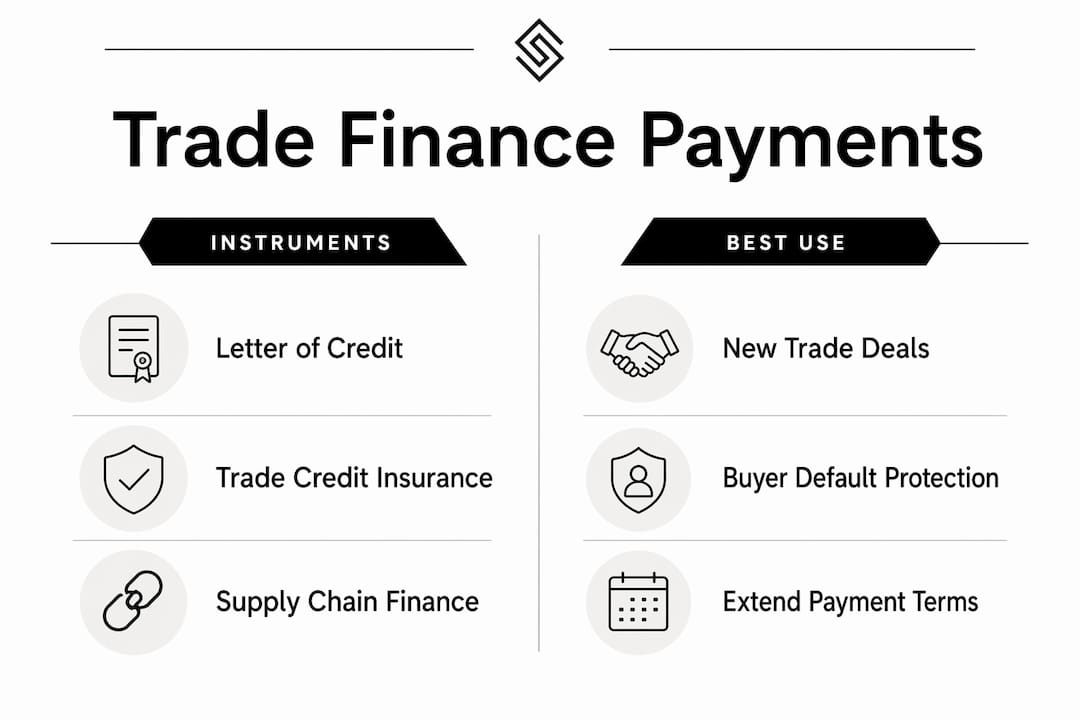
Trade credit insurance protects exporters against buyer default. If the importer fails to pay, the insurer covers the loss, typically up to a set percentage of the invoice value. This instrument works best for established trading relationships where open account terms are already in use but default risk remains a concern.
Supply chain finance (reverse factoring) lets buyers extend their payment terms while suppliers receive early payment at the buyer's credit rate. This mechanism bridges the payment gap without creating liquidity problems for suppliers. A large retailer might pay its suppliers in 10 days through a supply chain finance program while settling with the bank at 90 days, improving cash flow on both sides.
Factoring works differently. The exporter sells its outstanding invoices to a factoring company at a discount and receives immediate cash. This suits exporters who need working capital now and cannot wait 60 or 90 days for payment.
| Instrument | How it works | Best-use scenario |
|---|---|---|
| Letter of credit | Bank guarantees payment on document verification | New relationships, high-value deals |
| Trade credit insurance | Insurer covers buyer default losses | Open account terms with default risk |
| Supply chain finance | Buyer's bank pays supplier early; buyer repays later | Large buyers with strong credit ratings |
| Factoring | Exporter sells invoices at a discount for immediate cash | Exporters needing immediate working capital |
Each instrument addresses a different point of failure in the payment chain. Choosing the wrong one for your transaction type adds cost without reducing risk.
How trade finance payments reduce risk and build trust
Every cross-border transaction carries at least three categories of risk. Payment risk is the chance the buyer never pays. Performance risk is the chance the seller never ships. Credit risk is the chance either party cannot meet their financial obligations when due.
Trade finance payment instruments address all three by removing personal trust from the equation entirely. Banks substitute their creditworthiness for that of unknown trade partners, enabling deals that would otherwise be impossible. A small exporter in Colombia does not need to know the financial health of a buyer in South Korea. The buyer's bank has already vouched for them through the LC.
The key risks trade finance instruments address:
- Payment risk: LCs and trade credit insurance guarantee the exporter receives funds regardless of buyer behavior.
- Performance risk: LCs require shipping documents as proof of delivery before releasing payment, protecting the importer.
- Credit risk: Supply chain finance and factoring shift credit exposure from the exporter to a financial institution with stronger credit standing.
"Trade finance is not a product. It is a universe of solutions, each designed to match a specific risk profile with the right financial tool." — Trade Finance Global
The trust-bridging function of trade finance is what makes it indispensable. Two parties who have never met, operating under different legal systems and currencies, can complete a $2 million transaction with confidence because a bank has stepped into the middle.
Modern challenges in trade finance payments in 2026
Trade finance operations in 2026 still run largely on paper. Manual bank verification and paper documentation continue to dominate trade finance workflows globally, creating friction that slows transactions and increases error rates. A single LC can require 20 or more individual documents, each verified by hand. That process takes days, sometimes weeks.
Compliance is the second major friction point. Anti-money laundering and KYB checks impose significant compliance burdens on trade finance applicants, and banks often apply blanket, high-friction assessments that disproportionately affect small and mid-sized exporters. A startup importing goods for the first time faces the same compliance gauntlet as a multinational, even though their risk profile is entirely different.
The ICC has responded by promoting proportionate, risk-based compliance models that target supervisory attention where it is actually needed. This approach reduces duplicative checks and speeds up access for legitimate businesses. Electronic documents are gaining ground, but adoption remains slow due to legal complexity and jurisdictional gaps across different countries.
Pro Tip: Before going paperless with a trade partner, verify that both jurisdictions legally recognize electronic trade documents. Mismatched legal frameworks can invalidate an otherwise compliant LC.
Practical steps for finance managers using trade finance payments
Choosing the right trade finance instrument starts with a clear-eyed assessment of your transaction risk and liquidity position. A finance manager running a multi-currency business account for an import/export firm faces different priorities than a digital agency making one-off cross-border payments.
The core decisions every finance manager should make before executing a trade finance payment:
- Match instrument to risk. Use LCs for new counterparties and high-value deals. Use trade credit insurance for established open-account relationships. Use factoring when working capital is the primary constraint.
- Nail your documentation. LC discrepancies are the most common reason payment is delayed. Assign one person to manage document compliance from shipment to bank presentation.
- Clarify payment terms in the contract. Ambiguous terms create disputes. Specify currency, payment method, document requirements, and timelines before the deal is signed.
- Use a multi-currency account. FX exposure adds a layer of risk on top of payment risk. A foreign currency business account lets you hold, send, and receive in the transaction currency, removing unnecessary conversion costs and timing risk.
- Vet your banking partners. Not all trade finance providers apply the same compliance standards. Seek partners using proportionate KYB models that do not penalize legitimate SMEs with excessive friction.
Sigmaplatinum supports international businesses with multi-currency payment accounts and FX workflows built for exactly this kind of cross-border complexity. The platform's compliance-focused onboarding uses rigorous KYB checks, so finance managers can operate with confidence that their payment infrastructure meets current regulatory standards.
Key Takeaways
Trade finance payment instruments work because they replace personal trust with bank-backed document verification, making cross-border deals possible between parties who have never met.
| Point | Details |
|---|---|
| Core definition | A trade finance payment ties payment release to verified shipping documents, not personal trust. |
| Primary instrument | Letters of credit are the most widely used tool, guaranteeing payment upon bank-confirmed document compliance. |
| Instrument matching | Match each instrument to your risk: LCs for new deals, insurance for open accounts, factoring for liquidity needs. |
| Compliance friction | KYB and AML checks slow SME access; seek partners using proportionate, risk-based compliance models. |
| Digital gap | Paper-based processes still dominate in 2026; verify legal recognition of electronic documents before going paperless. |
The trust problem never really changes
I have spent years watching businesses treat trade finance as a back-office formality. They sign the contract, assume the bank will handle it, and then panic when a document discrepancy holds up payment for three weeks. The mechanics of trade finance are not complicated. The execution is where deals fall apart.
What strikes me most about this space is how little the fundamental problem has changed. Two parties who do not know each other need to exchange goods and money across borders. Banks solved this problem with letters of credit decades ago, and the core logic still holds. What has changed is the volume, the speed expectation, and the compliance environment around it.
The digitization push is real, but it is slower than the fintech headlines suggest. Legal frameworks in most jurisdictions have not caught up to electronic trade documents. Businesses that rush into paperless workflows without checking their counterparty's legal environment are creating new risks while trying to eliminate old ones.
My advice is straightforward. Pick your instruments deliberately. Manage your documents obsessively. And choose banking partners who treat compliance as a precision tool, not a blunt instrument applied equally to every applicant regardless of actual risk.
— Ahmed
How Sigmaplatinum supports your international payment operations
International trade demands payment infrastructure that keeps pace with your deals, not one that creates new bottlenecks.
Sigmaplatinum provides business payment accounts built for international companies managing multi-currency transactions, FX workflows, and cross-border payments. The platform's compliance-focused onboarding uses rigorous KYB checks and partner evaluations, so you get access to regulated payment infrastructure without the blanket friction of traditional banking. Import/export companies, consulting firms, and digital agencies use Sigmaplatinum to manage the payment side of their trade operations efficiently. If your business moves money across borders regularly, a purpose-built account is not optional. It is the foundation everything else runs on.
FAQ
What does trade finance payment mean in simple terms?
A trade finance payment is a bank-guaranteed payment mechanism where funds are released to an exporter only after verified shipping documents are presented. It replaces personal trust between trading partners with a bank's conditional guarantee.
What is the most common trade finance payment instrument?
The letter of credit is the most widely used trade finance payment instrument. It binds the importer's bank to pay the exporter once specific documents proving shipment are verified and compliant.
How does supply chain finance differ from factoring?
Supply chain finance is initiated by the buyer and lets suppliers receive early payment at the buyer's credit rate. Factoring is initiated by the seller, who sells invoices at a discount to receive immediate cash from a third-party financier.
Why do SMEs struggle with trade finance payments?
Banks often apply blanket KYB and AML compliance checks that create high friction for small exporters, regardless of their actual risk profile. The ICC promotes proportionate, risk-based compliance models to improve SME access.
Do I need a multi-currency account for trade finance payments?
A multi-currency account is not legally required, but it removes FX conversion costs and timing risk from your payment workflow. For businesses trading in multiple currencies, it is the most practical way to manage cross-border payment exposure.