
A business payment account is a dedicated financial account used exclusively to manage company transactions, separate from personal finances. Think of it as the operational backbone of your company's money flow. Unlike a personal checking account, this type of account is purpose-built for payroll, vendor payments, tax obligations, and client receipts. The industry standard term is a corporate payment account, though "business payment account" is the phrase most owners search for and most providers use in their product naming. Common formats include business checking accounts, merchant accounts, and EMI e-wallets, each serving a distinct function in your financial infrastructure. Services like PayPal Business, Stripe, and traditional banks like JPMorgan Chase all offer versions of these accounts, but they differ significantly in compliance requirements, settlement speed, and use case.
What is a business payment account and why does it matter?
A business payment account is defined as a financial vehicle used exclusively for company transactions, enabling operational efficiency, tax compliance, and professional credibility. This is not just a formality. Mixing personal and business funds is one of the most common and costly mistakes early-stage entrepreneurs make, and it creates real legal exposure.
Financial separation is a core business protection strategy, vital for audit readiness, tax compliance, and building trust with lenders and suppliers. When your business finances are clean and isolated, your accountant spends less time untangling transactions, your tax filings are more accurate, and your loan applications carry more weight with underwriters.

For agencies, consulting firms, and import/export companies, the stakes are even higher. A digital agency receiving payments from clients in five countries needs an account structure that can handle multi-currency receipts, FX conversion, and local disbursements without triggering compliance flags. A single personal account cannot do that job.
Pro Tip: Open your business payment account before you invoice your first client. Retroactively separating finances is far more time-consuming than starting clean.
What types of business payment accounts exist?
Account types include business checking accounts, business savings accounts, merchant accounts, and EMI e-wallets, each with distinct regulatory and operational roles. Understanding the difference between them prevents costly misconfigurations in your payment setup.
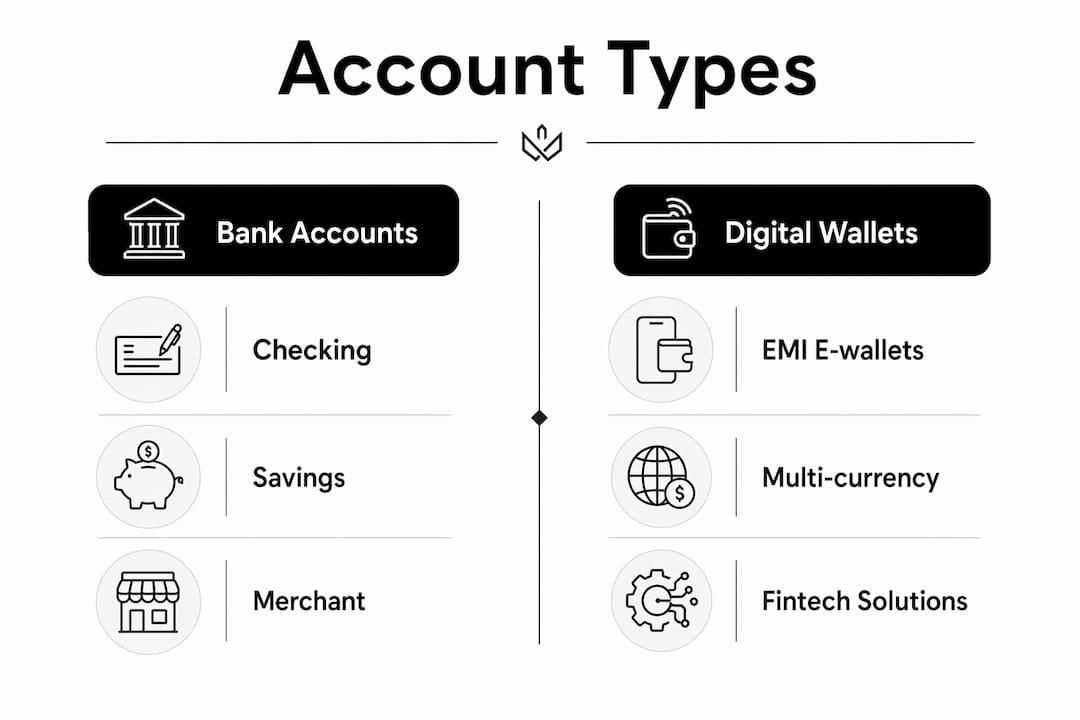
| Account Type | Primary Function | Best For |
|---|---|---|
| Business checking account | Day-to-day cash management, payroll, vendor payments | All business types |
| Merchant account | Credit/debit card authorization and settlement | Retail, e-commerce, SaaS |
| EMI e-wallet | Multi-currency digital payments, prepaid balances | Fintech, agencies, importers |
| Safeguarding account | Holding client funds separately under regulation | Payment institutions, brokers |
| Business savings account | Earning interest on operating reserves | Businesses with cash surplus |
Merchant accounts and business bank accounts serve different but complementary roles. The merchant account handles authorization and risk management when a customer pays by card. The business bank account stores and manages those funds after settlement. Confusing the two leads to gaps in your payment infrastructure.
EMI e-wallets, issued by Electronic Money Institutions regulated under frameworks like the EU's PSD2 or the UK's FCA, are the fastest-growing category in 2026. They offer multi-currency balances, virtual IBANs, and real-time payment rails that traditional banks cannot match on speed. For a business FX account or cross-border payment setup, an EMI e-wallet is often the most practical starting point.
Pro Tip: Most growing businesses need at least three account types: a main bank account for treasury, a merchant account for card processing, and an e-wallet or safeguarding account for multi-currency flows. One account rarely covers all three functions.
What are the key benefits of a dedicated business payment account?
Dedicated business payment accounts deliver five measurable advantages that directly affect your bottom line, your legal standing, and your ability to grow.
- Audit readiness. Clean separation of business and personal finances means every transaction has a clear business purpose. When the IRS or a foreign tax authority requests records, you produce them in hours, not weeks.
- Accurate expense tracking. Every payment in and out of a dedicated account is a business transaction by definition. This eliminates the manual sorting that wastes hours during tax season.
- Payroll and vendor payment support. Business checking accounts integrate directly with payroll platforms like Gusto and ADP, and with accounts payable tools like Bill.com, reducing manual processing.
- Business credit building. Consistent, on-time payments from a registered business account build your company's credit profile with bureaus like Dun and Bradstreet, which directly affects your borrowing capacity.
- Loan application credibility. Lenders require business bank statements as part of underwriting. Financial separation is fundamental for successful loan applications, and a well-maintained business account is the first document any lender requests.
The operational efficiency gains are significant too. Businesses that automate payment workflows through dedicated accounts reduce manual accounting entries by a measurable margin. The U.S. B2B payment automation market exceeds $50 billion annually, driven by digitized payments embedded in ERP and procurement software. That figure reflects how seriously mid-market and enterprise companies treat payment infrastructure as a competitive asset, not an administrative afterthought.
How does the onboarding and review process work?
Opening a business payment account requires passing mandatory Know Your Business (KYB) and Know Your Customer (KYC) vetting processes. These are not optional steps. Every regulated financial institution, from JPMorgan Chase to a fintech EMI, must verify your business identity before granting account access.
The b2b payment account review process typically requires the following documentation:
- Business registration certificate confirming your company's legal existence and jurisdiction.
- Ownership structure documentation identifying all beneficial owners holding more than 25% of the company.
- Director and shareholder ID verification including government-issued photo ID and proof of address.
- Tax identification number or equivalent, depending on your jurisdiction.
- Audited source-of-funds evidence showing where your operating capital originates.
- Business activity description explaining what your company does, who your clients are, and your expected transaction volumes.
Failure to provide clear, audited documentation is the main cause of application rejections. This is the single most preventable reason businesses get turned down, and it has nothing to do with the legitimacy of the business itself.
The business payment eligibility review timeline varies significantly by provider type. Traditional banks generally take 3 to 5 business days for settlement and often weeks for full account approval. Fintech providers frequently complete onboarding in 24 to 72 hours when documentation is complete and clean. For international businesses, the multi-currency account eligibility checklist is a practical starting point before submitting any application.
Pro Tip: Prepare a single PDF package containing all required documents before you start any application. Incomplete submissions are the primary reason onboarding stalls, not compliance failures.
What role do digital payment networks play in efficiency?
A business payment network is a platform that consolidates multiple payment types, including ACH transfers, wire transfers, virtual cards, and real-time payments, into a single interface. These networks are the infrastructure layer that makes modern B2B payment automation possible.
"Platforms with broad network effects minimize operational friction and optimize financial workflows, particularly for businesses managing dozens of supplier relationships simultaneously." — PitchGrade Research
The efficiency gains are concrete. Modern business payment networks reduce manual accounting entries by 50 to 80% by automating payment matching, reconciliation, and approval workflows. For a business processing 200 vendor invoices per month, that reduction translates directly into fewer staff hours and fewer errors.
| Payment Type | Typical Clearing Time | Automation Potential |
|---|---|---|
| ACH transfer | 1 to 3 business days | High |
| Domestic wire | Same day to 1 business day | Medium |
| International wire (SWIFT) | 2 to 5 business days | Medium |
| Real-time payment (RTP) | Seconds | Very high |
| Virtual card | Instant authorization | Very high |
Large digital payment networks with millions of pre-enrolled suppliers dramatically reduce the manual burden of vendor onboarding and improve payment success rates. This is the network effect in practice. When your payment platform already has your supplier enrolled, you skip the data entry, the bank detail verification, and the test transaction cycle entirely.
For agencies managing international client payments, platforms that combine multi-currency accounts with a broad payment network are particularly valuable. The agency multi-currency payment guide covers how to structure these workflows for maximum efficiency.
Key takeaways
A business payment account is the financial foundation every company needs to operate legally, efficiently, and credibly in 2026.
| Point | Details |
|---|---|
| Core definition | A business payment account is a dedicated account for company transactions, separate from personal finances. |
| Account types matter | Business checking, merchant accounts, and EMI e-wallets each serve distinct functions and should not be substituted for one another. |
| Compliance is non-negotiable | KYB and KYC documentation must be complete and audited before any provider will approve your account. |
| Digital networks multiply efficiency | Payment platforms that consolidate ACH, wires, and real-time payments reduce manual entries by up to 80%. |
| Multi-account strategy wins | Most businesses need at least three account types to cover treasury, card processing, and multi-currency flows. |
Why most businesses get their payment setup wrong
I have reviewed payment infrastructure for dozens of international businesses, and the same mistake appears repeatedly. Owners treat the business payment account as a single product to acquire rather than a system to design. They open one account, usually a basic business checking account at a local bank, and then try to force every payment function through it.
The result is predictable. Card payments get declined because there is no merchant account. International transfers take five days because the bank has no real-time payment rails. FX conversions happen at terrible rates because the account has no multi-currency capability. The business then patches each problem with a separate tool that does not integrate with the others, creating a fragmented mess that costs more to manage than a well-designed setup would have cost to build.
The businesses I have seen get this right share one habit. They map their payment flows before they open any account. They list every type of payment they expect to send and receive, the currencies involved, the expected volumes, and the settlement timing they need. That map tells them exactly which account types they need and which providers can serve each function.
The compliance piece surprises most owners too. Many assume that because their business is legitimate, onboarding will be fast and simple. The reality is that compliance teams at banks and fintechs are under significant regulatory pressure, and incomplete documentation triggers manual review queues that can delay approval by weeks. Preparing a clean, complete documentation package before you apply is not bureaucratic box-checking. It is the single most effective way to control your timeline.
— Ahmed
How Sigmaplatinum supports your business payment setup
Sigmaplatinum is a B2B fintech platform built specifically for international businesses that need more than a standard bank account can offer.
Sigmaplatinum provides tailored business payment account solutions for companies managing multi-currency transactions, FX workflows, and cross-border B2B payments. The platform connects businesses to regulated partners through a compliance-focused onboarding process that includes rigorous KYB checks and partner evaluations. Digital agencies, consulting firms, and import/export companies use Sigmaplatinum to access multi-currency accounts, real-time payment rails, and corporate financial tools without the complexity of managing multiple unconnected providers. If you are ready to build a payment infrastructure that matches your actual business needs, visit Sigmaplatinum to review account access and eligibility options.
FAQ
What is a business payment account?
A business payment account is a dedicated financial account used exclusively for company transactions, separate from personal finances. Common types include business checking accounts, merchant accounts, and EMI e-wallets, each serving a distinct operational role.
How is a merchant account different from a business bank account?
A merchant account processes credit and debit card payments as an intermediary, handling authorization and risk management. A business bank account stores and manages funds after settlement and handles payroll, vendor payments, and cash management.
What documents are needed to open a business payment account?
Most providers require business registration, beneficial ownership documentation, director ID verification, a tax identification number, and audited source-of-funds evidence. Incomplete documentation is the primary reason applications are rejected.
How long does the business payment account review process take?
Traditional banks typically take several weeks for full account approval, while fintech providers can complete onboarding in 24 to 72 hours when all documentation is submitted correctly and completely.
Do businesses need more than one payment account?
Most businesses benefit from a multi-account structure covering a main bank account for treasury, a merchant account for card processing, and an e-wallet or safeguarding account for multi-currency flows. Each account type has unique compliance and operational functions that a single account cannot replicate.