
A non-resident business account is a bank or payment account opened by a company whose owners or directors do not reside in the country where the account is held, primarily used for managing international payments and foreign currency. This type of account is the standard solution for cross-border businesses that need to pay overseas suppliers, hold multiple currencies, or access financial markets in a specific jurisdiction. Regulatory bodies like FinCEN require providers to apply KYB verification before approving any legal entity, regardless of size. Understanding what a non-resident business account requires, and what it delivers, is the first step toward building a functional international banking setup.
What is a non-resident business account and who needs one?
A non-resident business account is defined as a financial account held by a legal entity whose controlling owners or directors live outside the country where the account is registered. The industry term you will encounter most often is "non-resident corporate account," though fintech providers and payment platforms frequently use "international business payment account" as well. Both phrases describe the same structure.
The businesses that need these accounts fall into clear categories. Digital agencies billing clients in the U.S. or UK from abroad, consulting firms receiving retainers in foreign currencies, and import/export companies paying international suppliers all depend on non-resident business banking to function. Without a dedicated account in the target jurisdiction, these businesses face currency conversion losses, payment delays, and limited access to local payment rails.
The core purpose is separation and access. A non-resident account keeps international revenue and expenses distinct from domestic finances, which simplifies tax reporting and reduces foreign exchange risk. It also gives the business a local account number, which many clients and suppliers require before they will send or receive funds.

What are the compliance requirements when opening a non-resident business account?
KYB, or Know Your Business, is the corporate equivalent of KYC (Know Your Customer). KYB requires verifying the legal entity itself, its beneficial owners, and the legitimate purpose of the business before any account is approved. This is not optional. FinCEN's Customer Due Diligence rule mandates that all providers collect and verify beneficial owner details for every legal entity customer, with ongoing monitoring throughout the business relationship.
The documentation required typically includes:
- Certificate of Incorporation or Formation confirming the entity exists legally
- Operating Agreement or Articles of Association showing ownership structure
- Passports or government-issued IDs for all beneficial owners above a defined ownership threshold (commonly 25%)
- Proof of business address, such as a utility bill or lease agreement
- Source-of-funds explanation describing where the company's revenue originates
- Business purpose description outlining what the company does and who its clients are
Compliance requirements vary significantly by jurisdiction and provider. A fintech platform operating under an Electronic Money Institution license applies different standards than a traditional bank. The risk appetite of the provider also shapes what they will accept. A company with a complex multi-layer ownership structure faces more scrutiny than a straightforward two-owner LLC.
Onboarding failures most often occur because beneficial owner disclosures are incomplete or internally inconsistent. Providers check that ownership percentages add up correctly and that every controlling party is identified. If the corporate documents show three directors but only two are disclosed in the KYB form, the application stalls.
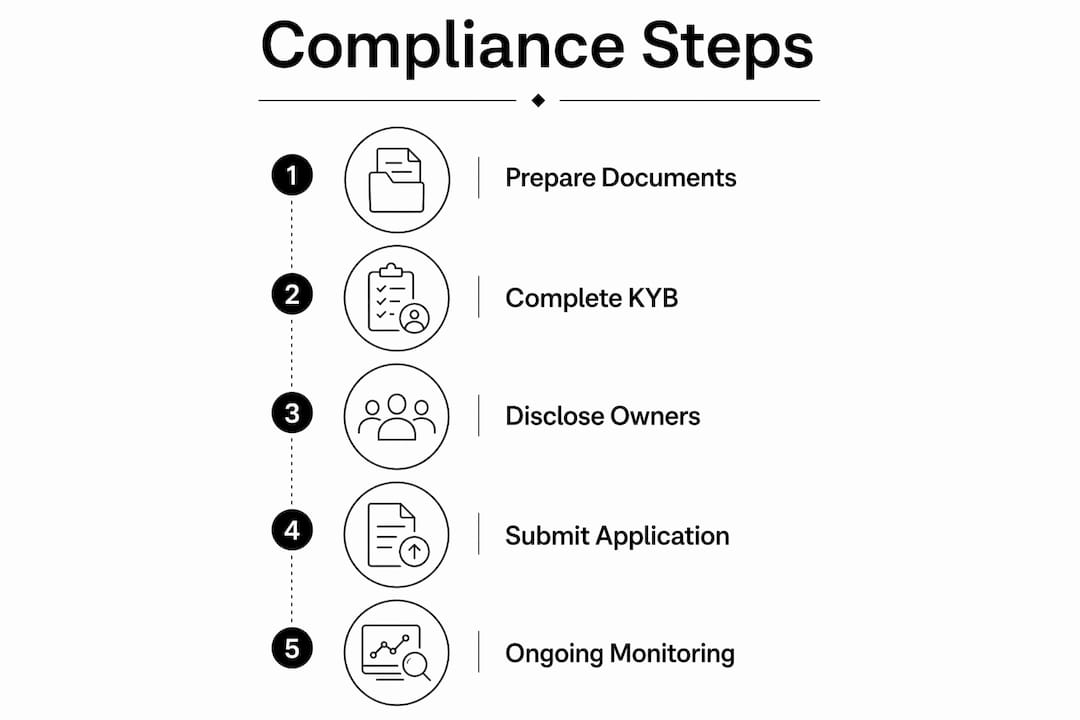
Pro Tip: Prepare a one-page ownership chart before you apply. Show every entity and individual in the ownership chain, with percentages. Providers use this to cross-reference your corporate documents, and having it ready cuts onboarding time significantly.
Ongoing monitoring is a real operational factor, not just a formality. Transaction behavior that deviates from the declared business profile can trigger account restrictions. If you open an account describing a consulting business and then start processing high-volume goods payments, expect questions.
How do country-specific regulations affect non-resident business bank accounts?
The jurisdiction where you open the account shapes every part of the process: the documents required, the timeline, the fees, and the likelihood of approval. The table below outlines the key differences across major markets.
| Jurisdiction | Key Requirements | Typical Timeline | Notable Challenges |
|---|---|---|---|
| United States | U.S. entity formation, IRS EIN, Certificate of Formation, beneficial owner IDs | 2–8 weeks (fintech); longer for banks | Director visits often required at traditional banks |
| United Kingdom | UK company registration, in-person representative meeting, business plan | 4 weeks to 3 months | Strict documentation; lower approval rates for offshore entities |
| European Union | Varies by country; EMI licenses common; KYB and AML compliance required | 2–6 weeks via EMI | Fragmented rules across member states |
| Singapore | ACRA registration, director presence, source-of-funds documentation | 4–8 weeks | High scrutiny for non-ASEAN entities |
| Hong Kong | Business registration, director ID, proof of business activity | 4–12 weeks | Significant in-person requirements; high rejection rates |
For U.S. accounts, the core requirements are a properly formed U.S. entity, an IRS Employer Identification Number (EIN), corporate formation documents, and identity proofs for all beneficial owners. Traditional banks in the U.S. often require a director to visit a branch in person, which creates a real barrier for overseas entrepreneurs. Fintech platforms have changed this. Many now offer fully remote account opening for U.S. entities, with faster onboarding and lower minimum deposits than traditional banks.
The UK process is notably more demanding. Opening a full UK business bank account generally requires at least one company representative to attend an in-person meeting in the UK. UK banks strongly prefer a UK-registered company with a local business address. Foreign-branch accounts face more documentation requirements and lower approval rates. The timeline runs from 4 weeks to 3 months depending on the bank and the complexity of the application.
For businesses targeting the UK market, UK-specific payment account setup through a regulated fintech provider is often faster and more accessible than a traditional bank route.
What are the operational benefits of non-resident business accounts?
Non-resident business accounts deliver concrete operational advantages that go beyond simply having a foreign account number. The core benefits include:
- Multi-currency holding: Keep balances in USD, GBP, EUR, and other currencies without converting every transaction. This reduces FX losses on recurring payments.
- International supplier payments: Pay overseas vendors directly from the account, avoiding third-party wire fees and delays.
- Separation of finances: Keep cross-border revenue and expenses distinct from domestic accounts, which simplifies bookkeeping and tax preparation.
- Access to local payment rails: A U.S. account gives access to ACH transfers. A UK account enables Faster Payments and BACS. These local rails are faster and cheaper than international wires.
- Debit cards and online banking: Most providers issue a business debit card and provide full online account management, allowing remote control of all transactions.
Non-resident accounts enable multi-currency holdings, international payment management, and access to global banking services that domestic accounts simply cannot provide. For a consulting firm billing U.S. clients in dollars while paying staff in euros, this structure eliminates a layer of unnecessary currency conversion at every transaction.
Pro Tip: If you regularly pay suppliers in a specific currency, hold a balance in that currency rather than converting at the time of payment. Most multi-currency accounts let you do this, and it removes exchange rate timing risk from your cash flow.
The benefits of non-resident accounts extend to client relationships as well. Receiving payment into a local account number builds credibility with clients who are unfamiliar with international wire transfers and prefer domestic payment methods.
What practical steps should entrepreneurs follow to open a non-resident business account?
A structured approach reduces the risk of rejection and cuts the time from application to active account. Follow these steps:
- Choose the right jurisdiction first. The country where you open the account determines the regulatory requirements, the currencies available, and the payment rails you can access. Match the jurisdiction to where your clients or suppliers are located.
- Form the legal entity. Most jurisdictions require a locally registered company. For the U.S., this means forming an LLC or corporation and obtaining an IRS EIN. For the UK, this means registering with Companies House.
- Prepare your documentation package. Gather your Certificate of Incorporation, Operating Agreement, passports for all beneficial owners, proof of business address, and a written source-of-funds explanation. Use the account application checklist to confirm you have everything before you apply.
- Decide between a traditional bank and a fintech platform. Traditional banks offer established credibility but require in-person meetings, longer timelines, and higher minimum balances. Fintech platforms offer remote onboarding and faster approval, which matters when you need the account operational quickly.
- Complete the KYB process honestly and completely. Disclose all beneficial owners above the threshold. Provide an ownership chart. Describe your business purpose clearly and accurately. Inconsistencies between your application and your corporate documents are the leading cause of rejection.
- Prepare for ongoing compliance. Once the account is open, keep your transaction behavior consistent with your declared business profile. Update your provider promptly if your business model or ownership structure changes.
Beneficial owner disclosure cannot be satisfied by corporate documents alone. Providers need the individuals behind the entity identified by name, with ID documents attached. This step trips up many applicants who assume that submitting company formation papers is sufficient.
Banks evaluate applications by whether they can verify the company and its owners through available records. When local public records are unavailable, the burden falls entirely on the documentation you provide. A complete, well-organized package is not just helpful. It is the deciding factor.
Key Takeaways
A non-resident business account requires a locally formed legal entity, complete KYB documentation, and accurate beneficial owner disclosure to gain approval and maintain access.
| Point | Details |
|---|---|
| Core definition | A non-resident account is held by a company whose owners do not reside in the account's country. |
| KYB is mandatory | All providers must verify the legal entity and its beneficial owners before approving any account. |
| Jurisdiction shapes the process | Requirements, timelines, and approval rates differ significantly across the U.S., UK, EU, and Asia. |
| Documentation quality decides outcomes | Incomplete or inconsistent beneficial owner disclosures are the leading cause of application rejection. |
| Fintech platforms offer faster access | Remote onboarding through regulated fintech providers is often faster than traditional bank routes. |
What I've learned from watching businesses get this wrong
Most entrepreneurs underestimate how much the compliance process resembles an audit. They treat the account application as a form to fill out rather than a case to build. The businesses that get approved quickly are the ones that arrive with a complete, internally consistent documentation package and a clear, honest description of what they do and where their money comes from.
The single most common mistake I see is treating beneficial owner disclosure as a box to check rather than a genuine verification exercise. Providers are not looking for a name. They are looking for a name, a passport, a percentage, and a clear line from that person to the entity on the application. When those pieces do not align, the application stops.
My practical suggestion: organize your documents into a single folder before you start any application. Label everything clearly. Include an ownership chart even if the provider does not explicitly ask for one. Transparency is not just a compliance requirement. It is the fastest path to an open account.
Sigmaplatinum: business payment accounts for international companies
International businesses that need efficient payment account access without the friction of traditional banking have a direct option.
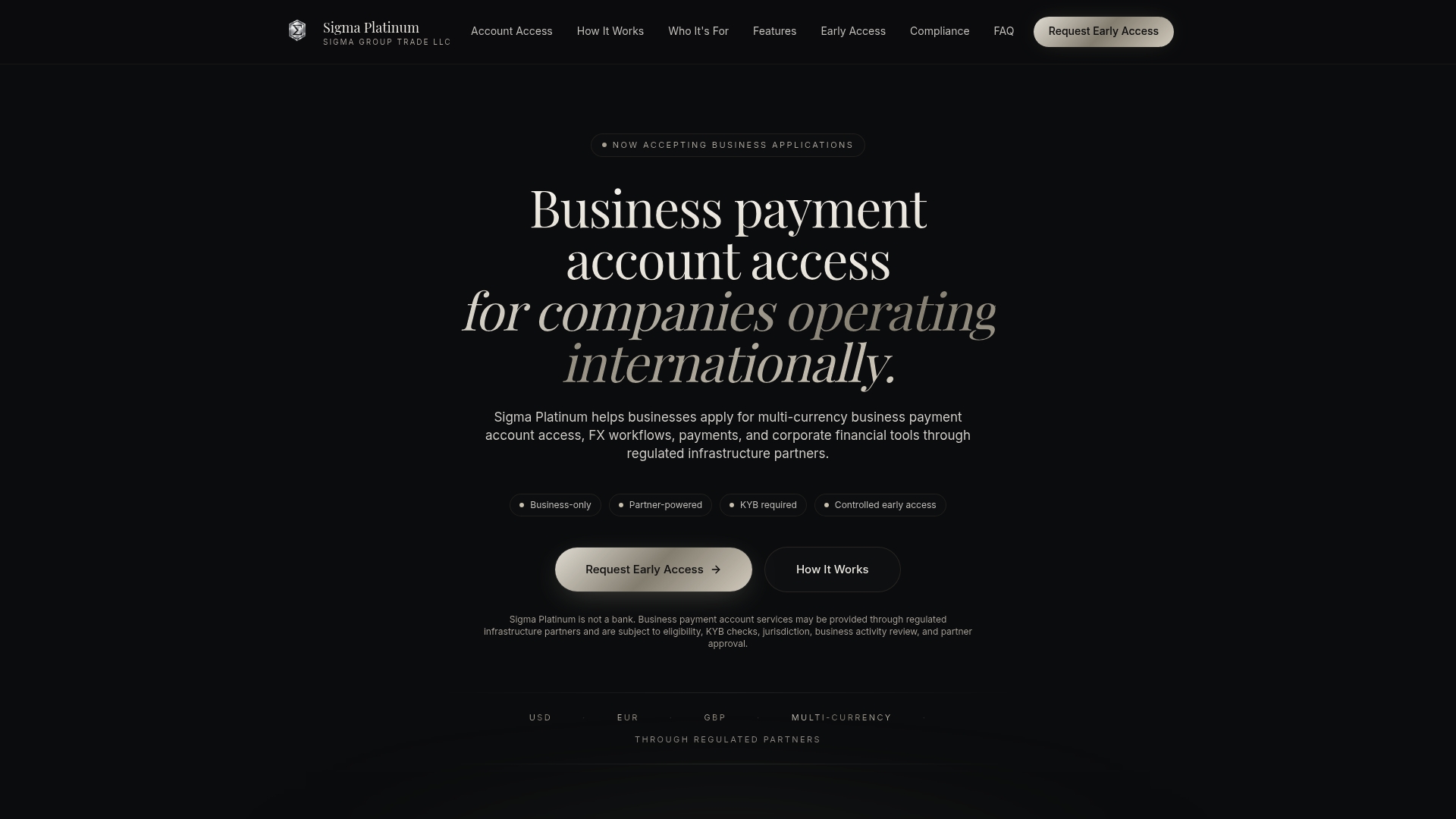
Sigmaplatinum is a B2B fintech platform built for exactly this use case. It provides business payment account solutions for international companies managing multi-currency transactions, FX workflows, and cross-border supplier payments. The onboarding process includes rigorous KYB checks and partner evaluations, so the accounts are backed by regulated infrastructure. Digital agencies, consulting firms, and import/export companies use Sigmaplatinum to access payment systems without the delays and in-person requirements that traditional banks impose. If your business operates across borders and needs a payment account that matches that reality, Sigmaplatinum is worth a direct look.
FAQ
What is a non-resident business account used for?
A non-resident business account is used to manage international payments, hold foreign currencies, pay overseas suppliers, and access local payment rails in a target jurisdiction. It separates cross-border financial activity from domestic accounts.
What documents are required for a non-resident account?
Typical requirements include a Certificate of Incorporation, an Operating Agreement, passports for all beneficial owners, proof of business address, and a source-of-funds explanation. The exact list varies by jurisdiction and provider.
How long does it take to open a non-resident business account?
Timelines range from 2 weeks with a fintech platform to 3 months with a traditional UK bank. The speed depends on the jurisdiction, the provider's risk appetite, and the completeness of your documentation.
What is KYB and why does it matter for non-resident accounts?
KYB (Know Your Business) is the process of verifying a legal entity, its ownership structure, and its business purpose before account approval. FinCEN's CDD rule requires all providers to complete this process for every business account applicant.
Can I open a non-resident business account remotely?
Fintech platforms often allow fully remote account opening, particularly for U.S. entities. Traditional banks in the UK and Asia typically require at least one in-person representative meeting before approving an account.
— Ahmed