
An international payment account is a specialized business account that enables consultants to receive, hold, and send funds across borders in multiple currencies without routing every transaction through a single domestic bank. For any consultant managing clients across the EU, US, or Asia Pacific, the advantages of global payment accounts are direct: lower foreign exchange costs, faster settlement, and cleaner compliance documentation. Sigmaplatinum is built specifically for this use case, offering regulated multi-currency account access through compliance-focused onboarding. The international payment account benefits consultants gain from this structure go well beyond convenience. They shape cash flow, tax reporting, and client relationships at a fundamental level.
1. What is an international payment account for consultants?
An international payment account is a business financial account that supports multiple currencies, named IBANs, and cross-border payment rails such as SWIFT, SEPA, and ACH. It differs from a standard business checking account in one critical way: it is designed to receive and hold foreign currency without forced conversion at the point of receipt.
Consultants working with EU clients need a EUR IBAN. Those billing US companies need USD account details. Multi-currency accounts solve this by giving you local account details in each major currency, so clients pay as if they are wiring domestically. That removes the friction of international wire fees on the client side and speeds up settlement on yours.
The core features that define these accounts include:
- Named IBANs in EUR, USD, and GBP for local-like payment receipt
- SWIFT connectivity for global transfers outside SEPA zones
- Multi-currency wallets that hold balances without automatic conversion
- FX conversion at institutional rates, executed on demand
- KYB-compliant onboarding with documented transaction profiles
International accounts support payment rails matched to each client region, which is the single most effective way to reduce transfer costs and delays.
2. Tax efficiency and financial privacy

Offshore and international accounts are legitimate, compliant tools for consultants managing revenue from multiple countries. Offshore banking is a standard practice for consultants working internationally, offering tax efficiency and financial privacy while maintaining full transparency with applicable laws.
The tax benefit is structural, not a loophole. Holding revenue in a foreign currency account until the optimal conversion moment can reduce realized exchange losses. It also separates income by source country, which simplifies reporting when you operate under different tax treaties.
Financial privacy is a related but distinct benefit. Keeping consulting revenue in a dedicated international account creates a clean audit trail. That separation protects you during tax reviews and makes it easier to document income by client jurisdiction.
Pro Tip: International income received through these accounts is still taxable in your country of residence and must be reported at the applicable exchange rate. Thorough record-keeping for tax compliance is not optional. Build a monthly reconciliation habit from day one.
3. Reduced foreign exchange costs
Currency conversion fees are a hidden cost that compounds across every invoice. A consultant billing €50,000 per quarter to EU clients through a domestic USD account can lose a meaningful percentage of that revenue to bank spread and conversion fees on every transfer.
International payment accounts eliminate that loss by letting you hold EUR until you choose to convert. You convert at institutional rates, not retail bank rates, and you convert on your schedule. That control is the core financial advantage.
Named IBANs in local currencies are the mechanism that makes this work. When a German client wires to your EUR IBAN, no conversion happens at receipt. You hold EUR, pay EUR-denominated expenses from it, and convert only the surplus to your home currency.
4. Faster payment settlement
SEPA transfers within the EU settle in one business day. ACH transfers in the US settle in one to two business days. SWIFT transfers, while slower, are the standard for global payments outside these zones. An international payment account that supports all three rails gives you the fastest possible settlement for each client region.
Consultants who rely on a single domestic account for all international receipts often wait three to five business days for SWIFT transfers to clear and convert. That delay creates cash flow gaps, especially for solo practitioners or small firms with tight operating budgets.
Cross-border payment setups that match the payment rail to the client region cut settlement time significantly. That speed improvement directly reduces the working capital you need to keep operations running between invoice cycles.
5. Compliance with global AML and KYC standards
Regulatory environments now enforce stringent Anti-Money Laundering and Know Your Customer rules across all international payment channels. AML/KYC compliance requires comprehensive documentation and clear explanations of transaction flows for any international consulting payment account.
This is not a burden unique to high-risk industries. Consulting firms face the same scrutiny because their revenue patterns, large irregular transfers from multiple jurisdictions, look similar to money laundering patterns on paper. The solution is documentation, not avoidance.
A compliant international payment account structures your KYB file to explain those patterns clearly. It documents your clients, your invoice cycles, your typical transfer amounts, and your counterparty countries. That documentation protects you from account freezes and rejection during periodic compliance reviews.
6. Payment redundancy and business continuity
Maintaining multiple, non-linked international accounts is the single most underrated risk management practice for consultants. Redundancy architecture that combines electronic money institutions with traditional accounts ensures uninterrupted operations if one account undergoes a compliance review or temporary freeze.
Account freezes happen to compliant businesses. A bank's automated compliance system flags an unusual transfer volume, and your account is locked while the review runs. If that account is your only payment channel, your business stops receiving revenue.
The fix is simple: maintain at least two active international accounts with different institution types. One electronic money institution account and one regulated bank account gives you coverage across both systems. If one is frozen, the other continues operating.
Pro Tip: Set up your second account before you need it. Opening a new account during a freeze is slow and stressful. A payment redundancy setup built in advance costs almost nothing and protects your entire revenue stream.
7. Improved client payment experience
Clients pay faster and more reliably when they can wire in their own currency to a local account number. A US client sending USD to your USD account details sees a domestic wire, not an international transfer. That means lower fees for them and faster receipt for you.
This matters for client retention. Consultants who make billing easy reduce the friction in the client relationship. A client who has to navigate international wire instructions, currency conversion questions, and bank fees on every invoice is a client who may eventually prefer a local provider.
Local currency acceptance also removes the exchange rate negotiation from your client conversations. You invoice in their currency, they pay in their currency, and you manage the conversion on your end at a time of your choosing.
8. Structured onboarding and provider selection
Consultants face high rejection rates from traditional banks because generic banks apply blanket de-risking policies to service businesses with international revenue. Selecting providers that specialize in the consulting sector improves approval rates and reduces compliance friction.
The onboarding process for a well-matched provider is faster and more predictable. They understand what a consulting firm's transaction profile looks like. They know that large, irregular inflows from multiple countries are normal for this business model, not suspicious.
Successful onboarding depends on a proactive transaction profile that details expected inward and outward volumes, counterparty countries, and currencies. Prepare this document before you apply. It signals to the compliance team that you understand the process and have nothing to hide.
9. Matching account features to your consulting niche
Not every international payment account fits every consulting model. The right account depends on your client geography, your invoice size, and whether you handle any crypto payments.
- EU-focused consultants need EUR IBANs and SEPA access as the baseline. SWIFT is secondary.
- US-focused consultants need USD account details and ACH support for domestic-style receipt.
- Mixed fiat and crypto consultants need accounts that support both payment types without forcing conversion at receipt.
- High-risk sector consultants (legal, financial advisory, defense) need providers with documented experience in regulated industries.
- Freelancers vs. firms: Solo practitioners often qualify for electronic money institution accounts with lighter onboarding. Larger consulting firms may need full corporate banking relationships with dedicated compliance support.
- Payment gateway integration: Consultants who sell digital products or retainers online may need a merchant ID attached to their international account for card payment acceptance.
The right payment solution aligns your account structure with your actual revenue flows, not a generic template.
10. Key features to evaluate when choosing an account
The table below outlines the core criteria consultants should assess before selecting an international payment account provider.
| Feature | What to look for |
|---|---|
| Multi-currency support | EUR, USD, GBP as minimum; additional currencies for your client regions |
| Named IBANs | Local account details per currency, not a single shared pool account |
| Payment rails | SEPA, SWIFT, ACH coverage matched to your client geography |
| FX conversion | Institutional rates with on-demand conversion, no forced auto-conversion |
| Compliance support | KYB assistance, transaction profile review, and documented onboarding process |
| Transfer speed | Same-day or next-day settlement within supported payment rails |
| Account redundancy | Option to hold multiple accounts or integrate with a second institution type |
Key takeaways
International payment accounts give consultants direct control over currency, compliance, and cash flow across every client geography they serve.
| Point | Details |
|---|---|
| Multi-currency IBANs reduce costs | Named IBANs in EUR, USD, and GBP eliminate forced conversion and lower FX fees. |
| Compliance documentation is non-negotiable | A proactive transaction profile prevents account rejection and reduces freeze risk. |
| Redundancy protects revenue | Maintaining two non-linked accounts across different institution types ensures continuity. |
| Provider specialization matters | Sector-matched providers approve consulting firms faster than generic banks. |
| Tax reporting requires clean records | International income must be reported at the applicable exchange rate in your home country. |
What I've learned about international payment accounts after years of advising consultants
Most consultants approach international payment accounts as a banking problem. They are not. They are a documentation and positioning problem.
The consultants I have seen get rejected by three banks in a row are rarely doing anything wrong. Their business is legitimate. Their clients are real. Their invoices are clean. The problem is that their application looks identical to a shell company on paper: irregular large transfers, multiple foreign counterparties, no physical premises. A generic bank's compliance algorithm cannot tell the difference.
The fix is not to find a more lenient bank. The fix is to build a business profile that explains your model clearly before anyone asks. That means a detailed transaction profile, a client list with business descriptions, copies of representative contracts, and a clear explanation of why you receive EUR from Germany and USD from Texas in the same month. When you walk into an onboarding process with that file ready, approval rates improve dramatically.
I have also watched consultants lose weeks of revenue because they had one account and it got frozen during a routine compliance review. That is an entirely avoidable problem. The redundancy architecture is not complex. It is two accounts at two different institution types, both active, both receiving at least occasional transactions so neither goes dormant.
The compliance trend I watch most closely is the increasing use of transaction monitoring algorithms that flag pattern deviations. If your account suddenly receives three times its normal monthly volume because you landed a large project, that spike can trigger a review. The solution is to notify your provider proactively when you expect an unusual transaction. That one habit prevents most freeze events.
— Ahmed
Sigmaplatinum's payment accounts for international consultants
Consulting firms that bill across multiple currencies and jurisdictions need more than a standard business account. Sigmaplatinum provides business payment accounts built specifically for international companies, with multi-currency support, compliance-focused onboarding, and KYB processes designed to handle the transaction profiles that generic banks reject.
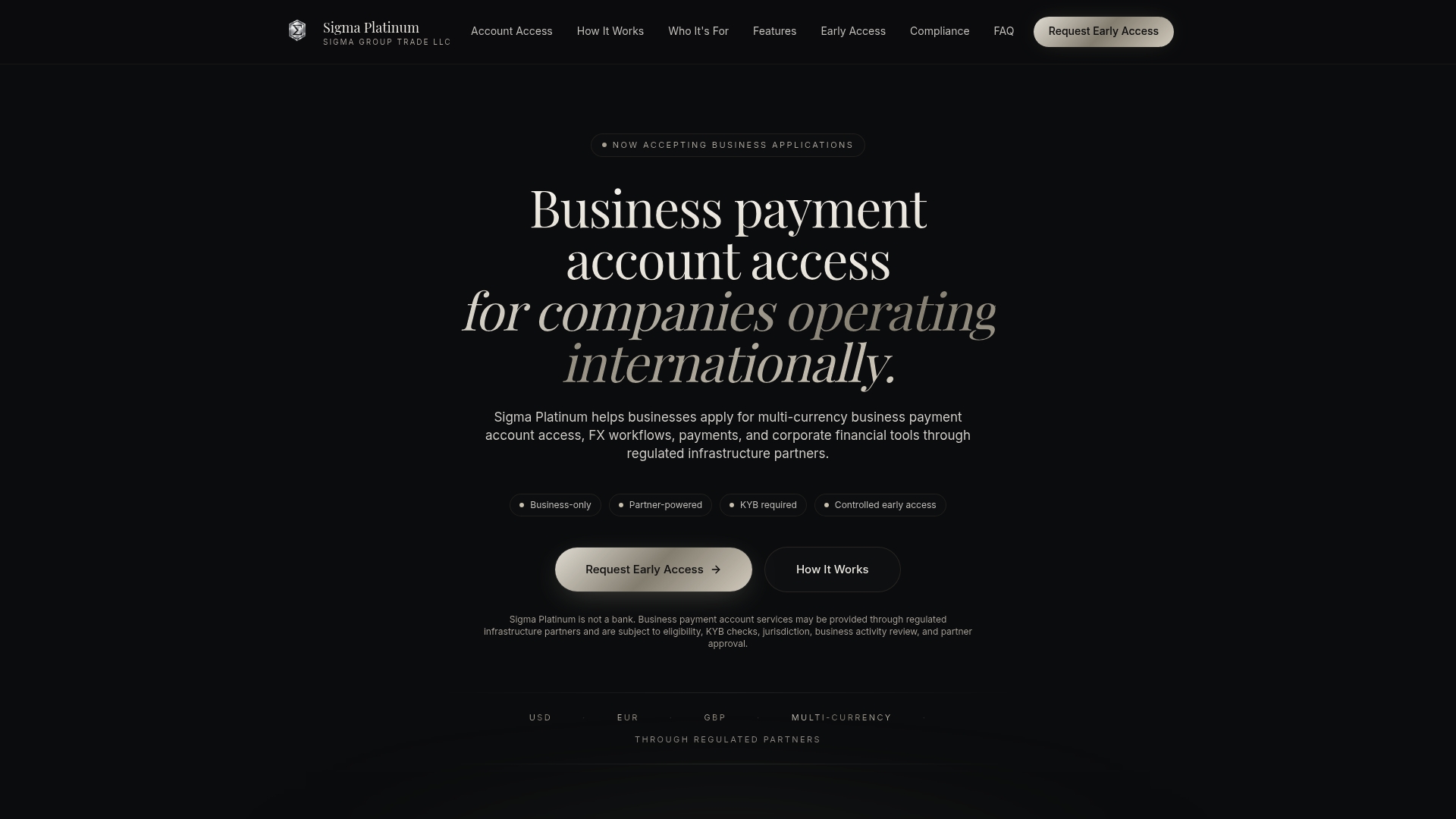
Sigmaplatinum's regulated partner network covers the account types, payment rails, and FX workflows that consulting businesses need to operate across the EU, US, and beyond. The onboarding process is structured to support your documentation preparation, not just collect it. If your consulting firm is ready to build a payment infrastructure that matches your actual client base, Sigmaplatinum is the place to start.
FAQ
What is an international payment account for consultants?
An international payment account is a business account that supports multiple currencies, named IBANs, and cross-border payment rails like SWIFT, SEPA, and ACH. It allows consultants to receive foreign currency without forced conversion and manage global payments from a single platform.
What are the main benefits of international accounts for consulting firms?
The primary benefits are reduced FX costs, faster settlement, improved client payment experience, and cleaner compliance documentation. Consultants also gain tax reporting clarity by separating income by currency and source country.
What is international payment account eligibility for consultants?
Eligibility typically requires a registered business entity, KYB documentation including ownership structure and business activity, and a transaction profile detailing expected payment volumes and counterparty countries. Providers specializing in consulting firms have more flexible eligibility criteria than traditional banks.
How do I choose payment account consultants or providers?
Select providers with documented experience in the consulting or professional services sector. Generic banks apply de-risking policies that reject consulting firms at high rates. Sector-matched providers understand irregular invoice cycles and multi-jurisdiction revenue patterns.
Why do consultants need payment redundancy?
A single account freeze can stop all incoming revenue. Maintaining two non-linked accounts across different institution types, such as one electronic money institution and one regulated bank, ensures business continuity during compliance reviews or temporary account restrictions.