
A cross-border payment account for agencies is a specialized financial account designed to handle international transactions efficiently, securely, and in full compliance with global regulations. Unlike a standard business bank account, it gives agencies access to multi-currency holding, local payment rails, and the compliance infrastructure required for international client payments. This cross-border payment account checklist for agencies covers every critical step, from document preparation and Know Your Business (KYB) verification to payment rail selection and ongoing compliance management. Platforms like Sigmaplatinum, standards like ISO 20022, and verification tools from providers like Routefusion and Paynfinity define the current best practice for agencies going global.
1. What documents do agencies need to open a cross-border payment account?
Opening a cross-border payment account requires a comprehensive set of corporate documents. Approval timelines range from days to weeks depending on jurisdiction and corporate complexity. Preparing a complete dossier from the start cuts that timeline significantly.
The core documents every agency must submit include:
- Certificate of incorporation — confirms the legal existence of the business in its home jurisdiction
- Articles of association — outlines the governance structure and shareholder rights
- Register of directors and shareholders — lists all individuals with control or ownership
- Beneficial ownership documentation — identifies any individual owning 25% or more of the company
- Proof of registered business address — a utility bill or official correspondence dated within 90 days
- Business activity description — a written summary of services, client geography, and revenue model
- Recent financial statements — typically the last 12 months of audited or management accounts
- Passport copies and proof of address for all directors and beneficial owners
Documents issued outside the account provider's jurisdiction often require notarization or an apostille stamp. Skipping this step is the single most common cause of onboarding rejection.
Pro Tip: Prepare a one-page business narrative that explains your agency's client base, transaction volumes, and the countries you pay into. Providers review this alongside your documents, and a clear narrative speeds up KYB approval.

2. Why a coherent KYB narrative matters as much as the documents
Submitting documents is necessary but not sufficient. A coherent dossier that includes a business narrative explaining your model, client geography, and expected transaction volume accelerates KYB approval beyond what documents alone can achieve. Compliance reviewers are assessing risk, not just checking boxes.
Your narrative should answer three questions directly: What does your agency do? Who are your clients and where are they located? What is the expected monthly payment volume and average transaction size? Agencies that answer these questions upfront reduce back-and-forth with compliance teams and shorten onboarding by days or weeks.
3. How do agencies verify beneficiary accounts before sending payments?
Verification in cross-border payments operates in two tiers. Tier 1 is bank account validation, which confirms that the account number and routing details are active and correctly formatted. Tier 2 is registry-sourced entity verification, which confirms the legal registration and good standing of the supplier or vendor receiving the payment.
Tier 2 verification is critical in countries where real-time bank verification rails do not exist. It prevents shell-company fraud by cross-referencing the payee against official business registries. Tiered verification combining both methods is the strongest defense against failed transactions and fraud in cross-border payments.
"Registry-sourced entity verification confirms the legal existence and good standing of the payee company, which is essential where real-time bank verification rails are unavailable."
4. What does ongoing compliance management require for agencies?
Cross-border payment accounts are regulated financial instruments requiring ongoing compliance management, not just a one-time account opening. The shift from acquiring an account to managing a compliance lifecycle is the defining challenge for agencies scaling internationally.
Ongoing compliance covers four areas:
- Periodic KYC refresh — re-verify director and beneficial owner identities on a schedule set by your provider, typically every 12 months
- Sanctions screening — screen all counterparties against OFAC, EU, and UN sanctions lists before every payment
- Transaction screening — flag payments that deviate from declared volume or geography patterns
- Message enrichment — attach full payer and beneficiary legal names, addresses, and payment purpose codes to every transaction at the point of initiation
ISO 20022 message standards support enriched data fields that reduce false positives and payment holds at intermediary banks. Agencies that enforce enriched messaging from day one experience fewer compliance flags and faster settlement.
5. What payment rails and currencies should agencies prioritize?
Payment rail selection directly affects transaction cost and settlement speed. Non-resident global accounts allow agencies to hold foreign currency and access domestic payment rails without setting up a local legal entity. That eliminates the $25–$50 wire fees that traditional correspondent banking charges per transaction.
The major local payment rails agencies should understand are:
| Payment Rail | Region | Settlement Speed | Best Use Case |
|---|---|---|---|
| SEPA Credit Transfer | European Union | 1 business day | EUR supplier payments |
| Faster Payments | United Kingdom | Near real-time | GBP contractor payments |
| ACH | United States | 1–2 business days | USD payroll and vendor payments |
| PIX | Brazil | Instant | BRL local payments |
| UPI | India | Instant | INR freelancer payments |
Named accounts, where the account is registered in your agency's legal name, carry more credibility with receiving banks than third-party holding accounts. Local RTGS (Real-Time Gross Settlement) access is critical for high-value payments that cannot tolerate delays.
Pro Tip: When evaluating account providers, ask specifically whether your account will be a named account or a pooled account. Named accounts reduce the risk of payment returns and compliance queries from receiving banks.
6. How does ISO 20022 affect agency payment success rates?
ISO 20022 is the global messaging standard that defines how payment data is structured and transmitted between financial institutions. Enforcing message enrichment with payer and beneficiary legal names, addresses, and payment purpose codes at transaction initiation prevents holds by intermediary banks. Compliance teams flag payments that arrive with incomplete remittance details, which delays settlement and triggers manual review.
Agencies sending payments across multiple corridors must treat ISO 20022 compliance as an operational requirement, not a technical detail. Every payment instruction should carry the full legal name of the sending entity, the full legal name of the beneficiary, a structured address for both parties, and a clear payment purpose code. This data travels with the payment through every correspondent bank in the chain.
7. What are the most common mistakes agencies make when setting up accounts?
The most frequent mistakes fall into three categories: incomplete documentation, weak KYB narratives, and insufficient payment data.
- Incomplete documents — missing apostille stamps, expired identity documents, or unsigned articles of association cause immediate rejection
- Vague business descriptions — providers reject applications that describe the agency as "consulting" without specifying services, clients, or payment corridors
- Missing beneficial ownership details — any individual owning 25% or more must be fully documented; omitting one owner halts the entire application
- Insufficient remittance details — payments sent without full beneficiary data or purpose codes are held by intermediary banks
- No dual approval process — agencies that allow single-person payment authorization for new vendors expose themselves to fraud and internal error
Operational delays caused by these mistakes cost agencies more than just time. Payment holds can damage supplier relationships and trigger compliance reviews that freeze account access entirely.
8. Should agencies use banks or nonbank payment providers?
Both banks and nonbank providers play critical roles in cross-border payments. Nonbank solutions integrate APIs that allow agencies to fund international payments directly from traditional accounts, without the overhead of maintaining multiple bank relationships. Effectiveness varies by payment corridor and transaction volume.
Banks offer regulatory credibility and direct access to SWIFT and local clearing systems. Nonbank providers offer faster onboarding, lower fees on specific corridors, and multi-currency accounts that banks rarely provide to smaller agencies. The best international payment account guide for agencies is not a choice between banks and nonbanks. It is a decision about which combination of providers covers your payment corridors at the lowest cost and highest compliance standard.
9. How should agencies structure their payment approval workflow?
Payment approval workflow is a compliance control, not just an operational preference. Agencies should enforce dual authorization for any payment to a new beneficiary, meaning two authorized signatories must approve the instruction before it is sent. This single control eliminates the most common vector for payment fraud targeting agencies.
Callbacks to known contacts at new vendor organizations add a second layer of verification before first payment. Agencies paying into high-risk corridors, defined by FATF guidance as jurisdictions with weak anti-money laundering controls, should apply enhanced due diligence to every transaction. Document the rationale for each payment in your records. Regulators and account providers both expect agencies to demonstrate that payment decisions are deliberate and traceable.
Key takeaways
A successful cross-border payment account setup for agencies requires complete documentation, tiered beneficiary verification, ISO 20022 compliant messaging, and continuous compliance management across the full account lifecycle.
| Point | Details |
|---|---|
| Documentation completeness | Submit all corporate documents with notarization or apostille stamps before applying. |
| KYB narrative quality | Include a business narrative covering services, client geography, and transaction volumes. |
| Beneficiary verification | Use both bank account validation and registry checks to prevent fraud and failed transfers. |
| Payment rail selection | Choose named accounts with local rail access to reduce fees and settlement delays. |
| Compliance lifecycle | Maintain periodic KYC refresh, sanctions screening, and enriched ISO 20022 messaging continuously. |
What I have learned managing cross-border compliance for agencies
The agencies that struggle most with cross-border payment accounts are not the ones with complex corporate structures. They are the ones that treat account opening as a one-time task. Compliance is a process that runs parallel to operations, and the moment an agency stops maintaining it, the account becomes a liability.
The most underrated part of the payment account setup checklist is the business narrative. I have seen well-documented applications stall for weeks because the compliance reviewer could not understand what the agency actually did or why it needed to pay into a specific country. A two-paragraph explanation of your business model, written clearly and attached to your application, does more work than a stack of certified documents.
The future of cross-border payment compliance will move toward real-time data sharing between providers and regulators. Agencies that build clean, documented payment records now will find re-verification and account upgrades far easier as those standards tighten. Start the compliance habit early. It compounds.
— Ahmed
How Sigmaplatinum supports agencies with international payment accounts
Sigmaplatinum is built specifically for agencies and international businesses that need compliant, multi-currency payment accounts without the complexity of traditional banking. The platform's onboarding process includes rigorous KYB checks and partner evaluations, so agencies arrive at their account ready to operate, not waiting in a compliance queue.
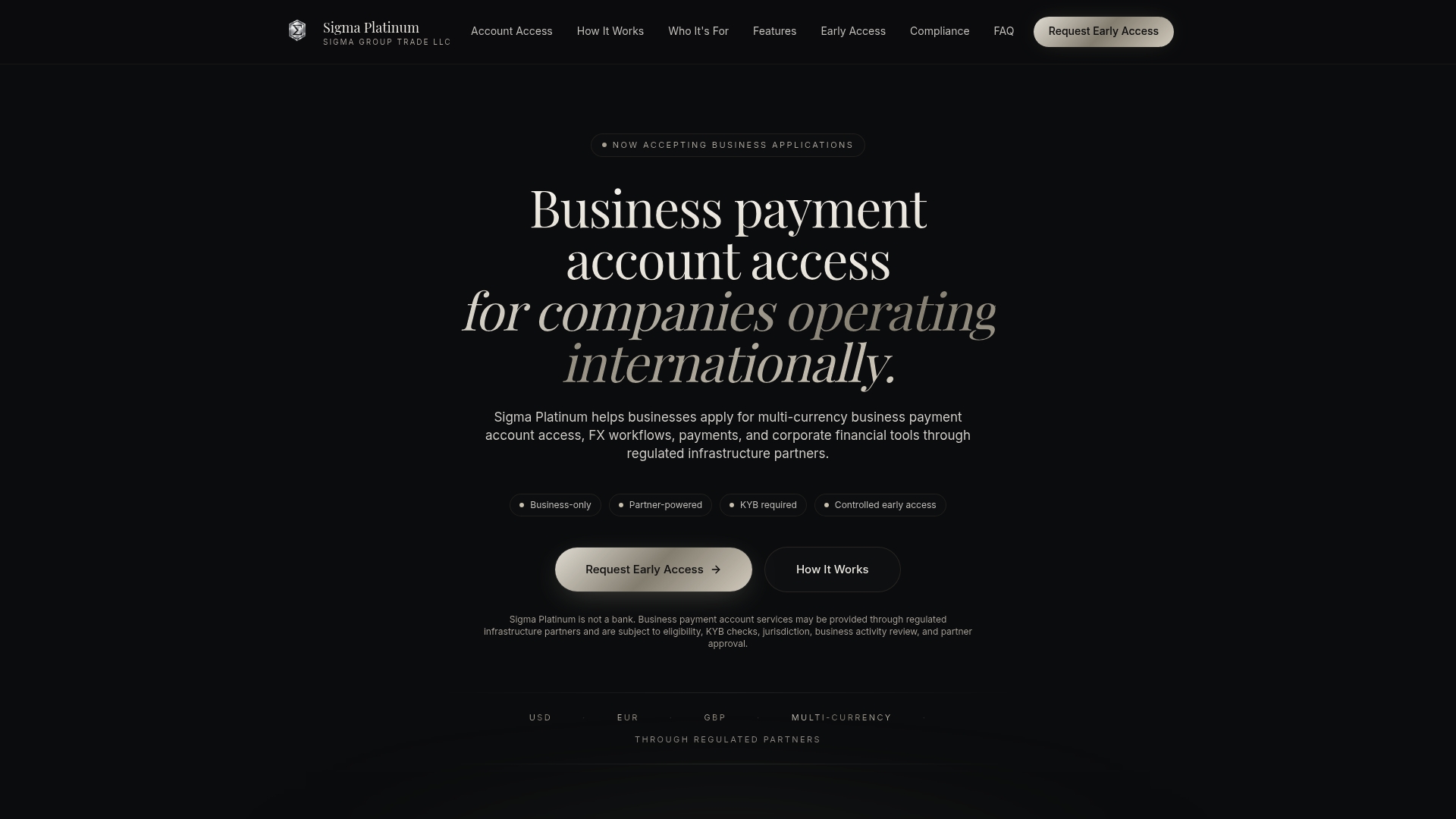
Sigmaplatinum provides access to multi-currency payment accounts with local payment rail integration across SEPA, Faster Payments, ACH, and more. Named accounts, FX workflows, and corporate financial tools are available through regulated partners. For agencies that need a payment account that works across borders without the overhead, Sigmaplatinum is the direct path. You can also explore the 2026 business guide to compare providers and find the right fit for your payment corridors.
FAQ
What is a cross-border payment account for agencies?
A cross-border payment account is a regulated financial account that allows agencies to send, receive, and hold funds in multiple currencies across international borders. It differs from a standard business account by providing access to local payment rails, multi-currency holding, and compliance infrastructure for international transactions.
What documents are required to open an international payment account?
Agencies must submit a certificate of incorporation, articles of association, a register of directors and shareholders, beneficial ownership documentation, proof of business address, and recent financial statements. Documents from foreign jurisdictions typically require notarization or an apostille stamp.
How does ISO 20022 improve cross-border payment success?
ISO 20022 defines enriched data fields that carry full payer and beneficiary details through every bank in the payment chain. Payments with complete legal names, addresses, and purpose codes experience fewer holds and faster settlement at intermediary banks.
What is the difference between a named account and a pooled account?
A named account is registered in your agency's legal name, giving receiving banks a clear counterparty identity. A pooled account is held by the provider and shared across multiple clients, which increases the risk of payment returns and compliance queries.
How often do agencies need to refresh KYC documentation?
Most regulated providers require KYC refresh every 12 months, though high-risk account profiles may trigger more frequent reviews. Agencies should treat periodic re-verification as a scheduled operational task, not a reactive compliance event.