
A business account application checklist for 2026 is a structured set of documents and compliance steps that determines whether your account opens in days or stalls for weeks. For UK and GCC business owners targeting international payments, the stakes are higher than ever. Companies House identity verification reforms took effect in november 2025, and GCC banks have tightened Know Your Business (KYB) dossier standards. Getting your 2026 application requirements right from the start is the difference between a live account and a resubmission cycle.
1. What are the key documents required for UK business account applications in 2026?
UK business account applications in 2026 require a specific set of documents covering identity, company registration, and business activity. Missing or outdated items in any category triggers delays, not just requests for more information.
Identity and address proof

Every director and signatory needs government-issued photo ID plus a recent proof of address. Banks apply strict age limits by document type. Bank or credit card statements must be less than 3 months old. Utility bills must be less than 6 months old. Mortgage statements or council tax bills must be less than 12 months old. Using a utility bill from 7 months ago is one of the most common reasons applications stall.
Company registration documents
Limited companies must provide their Companies House registration number, certificate of incorporation, and a current confirmation statement. The Companies House identity verification mandate for new directors and Persons with Significant Control (PSCs) started 18 november 2025. Any director registered after that date must have completed identity verification before the account application goes in.
Business activity disclosures
Banks require a clear picture of what your business does and how money will move. You need to declare your expected annual turnover, average transaction values, and the countries you trade with. For businesses handling international payments, this section carries extra weight. Vague descriptions like "general trading" create friction. Specific descriptions like "B2B software licensing to UAE and Saudi Arabia clients" move faster.
Beneficial ownership
Beneficial ownership disclosure covers every individual who owns or controls 25% or more of the company. Missing even one qualifying owner triggers additional Anti-Money Laundering (AML) scrutiny and often a full resubmission. Include full name, date of birth, nationality, and address for each person.
- Government-issued photo ID for all directors and signatories
- Proof of address meeting document-specific age limits
- Companies House registration number and certificate of incorporation
- Current confirmation statement and articles of association
- Beneficial ownership details for all 25%+ shareholders
- Business activity description with expected turnover and transaction flows
- Annual accounts (if the company has been trading)
Pro Tip: Create a compliance folder with subfolders for identity, company registration, and business activity. Date-stamp each document when you add it. This prevents the common mistake of submitting a proof of address that was valid when you gathered it but expired by the time you applied.
2. What documents and information are essential for GCC business account applications in 2026?
GCC business account applications, particularly in the UAE, follow a document structure that mirrors UK requirements in purpose but differs significantly in format and grouping. Banks in the GCC expect a coherent KYB dossier rather than individual documents submitted piecemeal.
Company registration and licensing
The foundation of any GCC application is the trade license, certificate of incorporation, and Memorandum and Articles of Association (MOA). These must be current and match the company name exactly across all other documents. A trade license that expired last month, even by one day, stops the application immediately.
Shareholder, director, and signatory identities
Every shareholder, director, and authorized signatory needs a valid passport copy and proof of UAE or home-country address. For GCC nationals, an Emirates ID or equivalent national ID is also required. Banks cross-reference these against the trade license and MOA to confirm that the people signing the application actually have authority to do so.
UBO declarations and source of funds
Ultimate Beneficial Ownership (UBO) declarations are mandatory across GCC jurisdictions. The UAE's UBO register requires companies to file beneficial ownership data with the relevant authority, and banks verify this during onboarding. Beyond ownership, you need a written explanation of your source of funds. For import/export companies or digital agencies handling cross-border payments, this means documenting where client payments originate and how funds flow through the business.
Business profile
A one to two page business profile explaining your industry, client base, revenue model, and expected transaction volumes gives the bank's compliance team a clear picture. This document does more work than most applicants realize. It is the narrative that ties all other documents together.
- Current trade license and certificate of incorporation
- Memorandum and Articles of Association
- Passport copies for all shareholders, directors, and signatories
- Emirates ID or equivalent national ID for GCC nationals
- UBO declaration filed with the relevant authority
- Proof of company address (tenancy contract or utility bill)
- Proof of individual addresses for all key persons
- Source of funds explanation with supporting documentation
- Business profile covering industry, clients, and transaction flows
Pro Tip: Organize your GCC KYB file into five labeled sections: company registration, ownership and signatories, address proofs, source of funds, and business profile. Banks that receive a well-organized file process it faster because their compliance teams can work through it without back-and-forth requests.
3. How to prepare for and pass KYC and KYB checks effectively in 2026
KYC and KYB are not the same process, and treating them as identical is a costly mistake. KYC covers identity verification needed to create the account. KYB is the deeper business verification that unlocks broader account capabilities, including international payment access and higher transaction limits.
Most 2026 account workflows follow an incremental model. You pass KYC to get baseline access, then complete KYB to unlock full functionality. This means a business can technically open an account but find it restricted to domestic transactions until KYB is approved. For businesses that need cross-border payment capabilities from day one, completing the full KYB package upfront is the right approach.
- Gather all ownership and control records before starting the application. Gaps discovered mid-process cause the longest delays.
- Align your AML documentation with your business activity description. The source of funds explanation must match the transaction flows you declared.
- Verify that all signatories have completed identity verification where required, including Companies House verification for UK directors registered after november 2025.
- Submit a complete file rather than the minimum required. Banks approve complete files faster than incomplete ones that generate follow-up requests.
- For GCC applications, confirm your UBO register filing is current before submitting to the bank.
Compliance readiness, meaning a credible business rationale backed by consistent ownership documentation, is a bigger obstacle than missing basic documents for most 2026 UK business account applications.
The most effective preparation treats KYB as a storytelling exercise. Every document in the file should answer one of three questions: who owns and controls this business, what does this business do, and where does the money come from and go. A file that answers all three clearly and consistently moves through compliance review without friction.
4. Comparing UK and GCC business account application checklists for international payments in 2026
UK and GCC checklists share the same underlying logic but differ in format, timing, and the weight given to specific documents. Cross-border businesses operating in both regions benefit from harmonizing their documentation so that ownership disclosures, address proofs, and business descriptions are consistent across both applications.
| Checklist element | UK requirement | GCC (UAE) requirement |
|---|---|---|
| Company registration | Companies House number, certificate of incorporation | Trade license, certificate of incorporation, MOA |
| Identity verification | Photo ID plus Companies House verification for post-Nov 2025 directors | Passport plus Emirates ID or national ID |
| Beneficial ownership | 25%+ owners disclosed per AML rules | UBO declaration filed with UAE authority |
| Proof of address | Document-specific age limits (3–12 months) | Tenancy contract or utility bill for company and individuals |
| Business activity | Turnover, transaction volumes, trading countries | Business profile page plus source of funds narrative |
| Verification workflow | KYC then KYB; Companies House reforms add identity step | KYB dossier submitted as a complete package |
| International payment readiness | Declared transaction flows and counterparty countries | Source of funds explanation tied to cross-border activity |
The most significant difference is workflow structure. UK applications often proceed document by document, with banks requesting additional items as they review. GCC banks expect a complete dossier upfront. Businesses applying in both regions should build the GCC-style complete package first, then adapt it for the UK application. This approach prevents the piecemeal submission pattern that slows UK applications down.
For multi-currency account applications in either region, the international payment narrative carries extra weight. Declaring specific currencies, counterparty countries, and expected monthly volumes gives compliance teams the context they need to approve cross-border capabilities quickly.
5. Pro tips and common mistakes to avoid when completing your business account application checklist in 2026
The most common reason business account applications fail in 2026 is not missing documents. It is documents that are present but wrong. Proof of address recency is the leading failure point in UK applications, with each document type carrying a different maximum age.
- Never submit a utility bill older than 6 months or a bank statement older than 3 months as proof of address.
- Disclose every 25%+ beneficial owner without exception. One missing owner stalls the entire application.
- Write your business activity description in specific terms. Name your industry, your clients' industries, and the countries involved.
- For new companies with no trading history, use a business plan with projected turnover and transaction volumes instead of annual accounts.
- Foreign-owned businesses applying in the UK should include the parent company's registration documents and ownership structure alongside the UK entity's documents.
- Match every name, address, and company detail exactly across all documents. A director listed as "Mohammed Al-Rashid" in one document and "M. Rashid" in another triggers a verification request.
Digital-first UK banks use app-based photo ID and biometric selfie matching to approve accounts in minutes. Legacy banks using manual review take days. If speed matters, choosing a provider with digital verification built into the onboarding process cuts approval time significantly.
Pro Tip: Before submitting, read your application as if you are the compliance officer reviewing it. Ask: does this file clearly explain who owns the business, what it does, and how money moves? If any answer is unclear, add a one-paragraph explanation. That extra context prevents the most common follow-up requests.
Key takeaways
A complete, well-organized business account application file, covering identity, ownership, business activity, and source of funds, is the single most reliable way to secure approval without resubmission in 2026.
| Point | Details |
|---|---|
| Document recency matters | Proof of address must meet document-specific age limits: 3 months for bank statements, 6 months for utility bills. |
| Beneficial ownership is non-negotiable | Disclose every individual owning 25% or more to avoid AML delays in both UK and GCC applications. |
| KYC and KYB are separate steps | Passing KYC opens a basic account; completing KYB unlocks international payment capabilities. |
| GCC requires a complete dossier | Submit all GCC documents as one organized package rather than responding to individual bank requests. |
| Consistency across jurisdictions | Businesses operating in both UK and GCC should align ownership disclosures and business descriptions across both applications. |
What I've learned about the 2026 application process that most guides won't tell you
Most articles on this topic treat the business account application as a document collection exercise. That framing misses the real challenge. Banks are not just checking boxes. They are deciding whether they trust your business enough to move money on your behalf.
The businesses I see get approved fastest are not the ones with the most documents. They are the ones whose documents tell a coherent story. A consulting firm with three directors, two of whom are UAE nationals and one a UK resident, needs to explain that structure clearly. Not because the bank suspects wrongdoing, but because compliance teams work faster when they understand what they are looking at.
The Companies House identity verification changes that started in november 2025 caught a lot of UK businesses off guard. Directors who had not completed verification were creating bottlenecks in applications that should have been straightforward. The lesson is to treat regulatory updates as part of your checklist preparation, not as something to deal with after you start the application.
My strongest advice for cross-border businesses is to build one master compliance file and maintain it continuously. Update address proofs every quarter. Refresh your business profile when your revenue model changes. When you need to apply for a new account or expand your payment capabilities, you pull from the master file rather than scrambling to gather documents under deadline pressure.
The businesses that struggle most are the ones that treat account applications as one-time events. The ones that succeed treat compliance readiness as an ongoing practice.
— Ahmed
How Sigmaplatinum supports business payment account access in 2026
Sigmaplatinum is built for international businesses that need payment accounts without the friction of traditional banking onboarding.
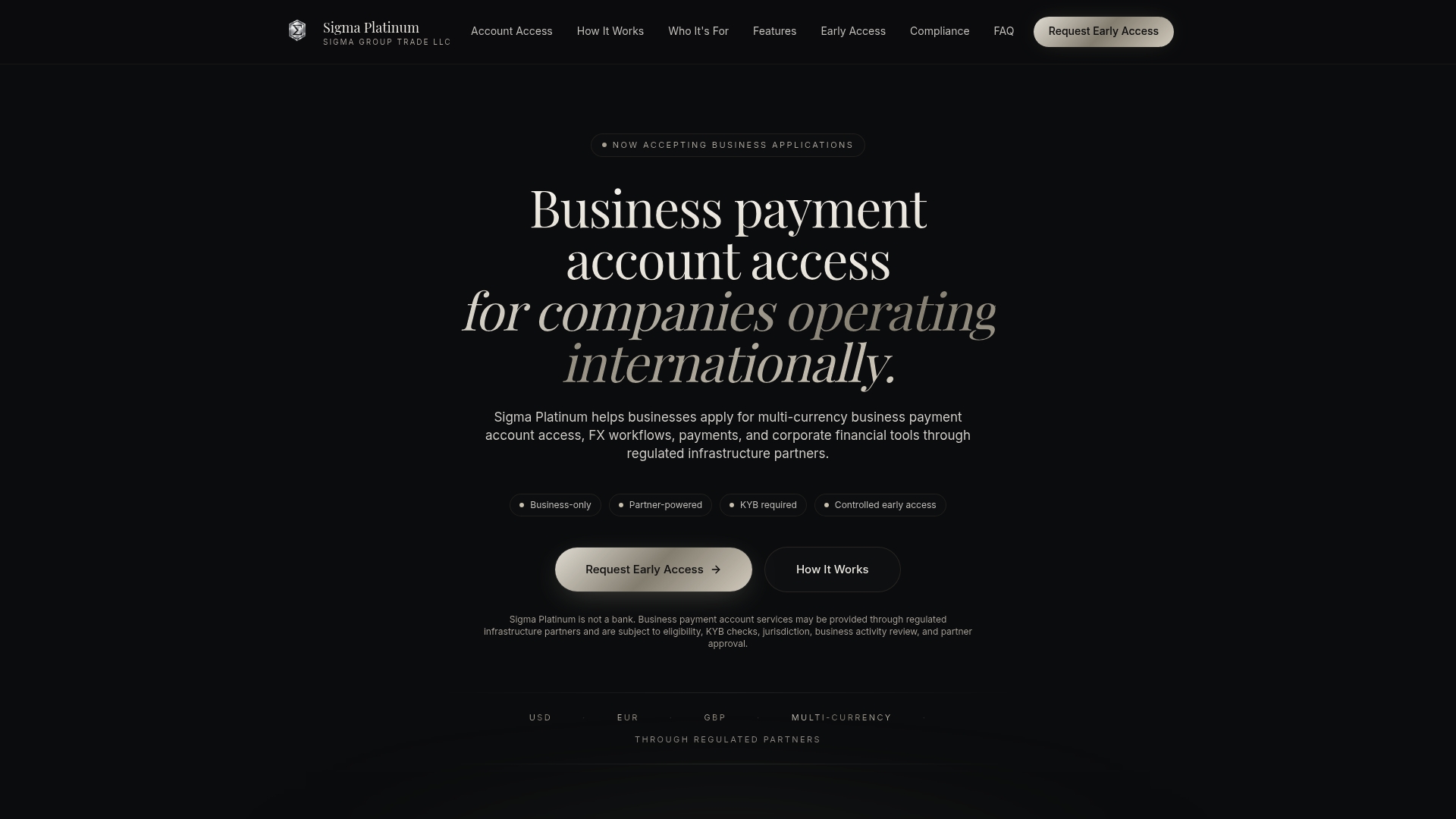
The platform gives UK and GCC businesses access to multi-currency payment accounts through regulated partners, with a compliance-focused onboarding process that includes KYB checks aligned with 2026 requirements. Digital agencies, consulting firms, and import/export companies use Sigmaplatinum to manage FX workflows and cross-border transactions without navigating legacy bank processes. The onboarding model is built around the same document logic covered in this guide, so businesses that prepare their checklist correctly move through the Sigmaplatinum process quickly. For businesses ready to apply, the eligibility criteria guide is the right starting point.
FAQ
What documents do I need to open a UK business account in 2026?
UK business account applications require government-issued photo ID, proof of address meeting document-specific age limits, Companies House registration details, beneficial ownership disclosure for all 25%+ owners, and a business activity description including expected turnover and transaction flows.
What is the difference between KYC and KYB for business accounts?
KYC verifies individual identity to create the account, while KYB is a deeper business-level verification that unlocks full account capabilities including international payment access and higher transaction limits.
What documents do GCC businesses need for a corporate bank account in 2026?
GCC applications require a current trade license, certificate of incorporation, Memorandum and Articles of Association, passport copies for all shareholders and directors, a UBO declaration, proof of company and individual addresses, and a source of funds explanation with a business profile.
How long does proof of address need to be valid for a UK business account application?
Bank and credit card statements must be less than 3 months old, utility bills less than 6 months old, and mortgage or council tax documents less than 12 months old to be accepted as valid proof of address.
How can UK and GCC businesses speed up their account application approval?
Submitting a complete, well-organized file upfront, with consistent ownership details, specific business activity descriptions, and current address proofs, reduces back-and-forth requests and cuts approval time significantly in both regions.