
A GBP EUR USD multi-currency account is a single business account that holds separate balances in British pounds, euros, and US dollars without forcing immediate currency conversion. The industry term for this structure is a multi-currency account, and understanding how it works is the foundation of any solid GBP EUR USD business account guide. For UK and international business owners paying suppliers in euros, billing US clients in dollars, and operating in sterling, this account type eliminates the costly cycle of converting funds every time money crosses a border.
What is a GBP EUR USD account and how does it work?
A multi-currency account holds GBP, EUR, and USD in three separate balances within one platform. You receive funds in each currency and spend from each balance independently. Conversion happens only when you choose to move money between currencies, not automatically on receipt.
The practical mechanics rely on local payment infrastructure for each currency:
- GBP payments move through Faster Payments, the UK's near-real-time transfer network, using a standard sort code and account number.
- EUR payments route through SEPA, the Single Euro Payments Area infrastructure, using an IBAN assigned to your account.
- USD payments arrive via the US ACH network using a routing number and account number.
SEPA moves EUR while Faster Payments moves GBP in near real-time. That distinction matters because each network has different settlement windows and fee structures.
The critical advantage is the local receiving detail. When a French client pays your EUR IBAN, they make a domestic SEPA transfer. When a US client pays your routing number, they send a domestic ACH payment. Neither transaction triggers an international SWIFT wire. Local receiving details prevent fees of up to $30 per transaction that SWIFT transfers would otherwise incur.

Pro Tip: Set up your EUR IBAN and USD routing number before you invoice your first international client. Sending an invoice with local details from day one avoids the awkward conversation of asking clients to resend payments.
A typical transaction flow looks like this: a US agency pays your USD routing number via ACH, funds land in your USD balance, you hold them until the EUR/USD rate is favorable, then convert at a time you choose. That control over timing is what separates a multi-currency account from a standard bank account that converts on arrival at whatever rate the bank sets that morning.
What are the fees for GBP, EUR, and USD multi-currency accounts?
Fee structures vary significantly between provider types, and the difference compounds quickly at volume. High-street banks charge 2.5–4% FX conversion margins, while specialist fintech providers offer spreads from 0.3% to 1.0%. On a £100,000 annual FX volume, that gap represents £2,200 to £3,700 in additional cost at the bank rate versus the specialist rate.
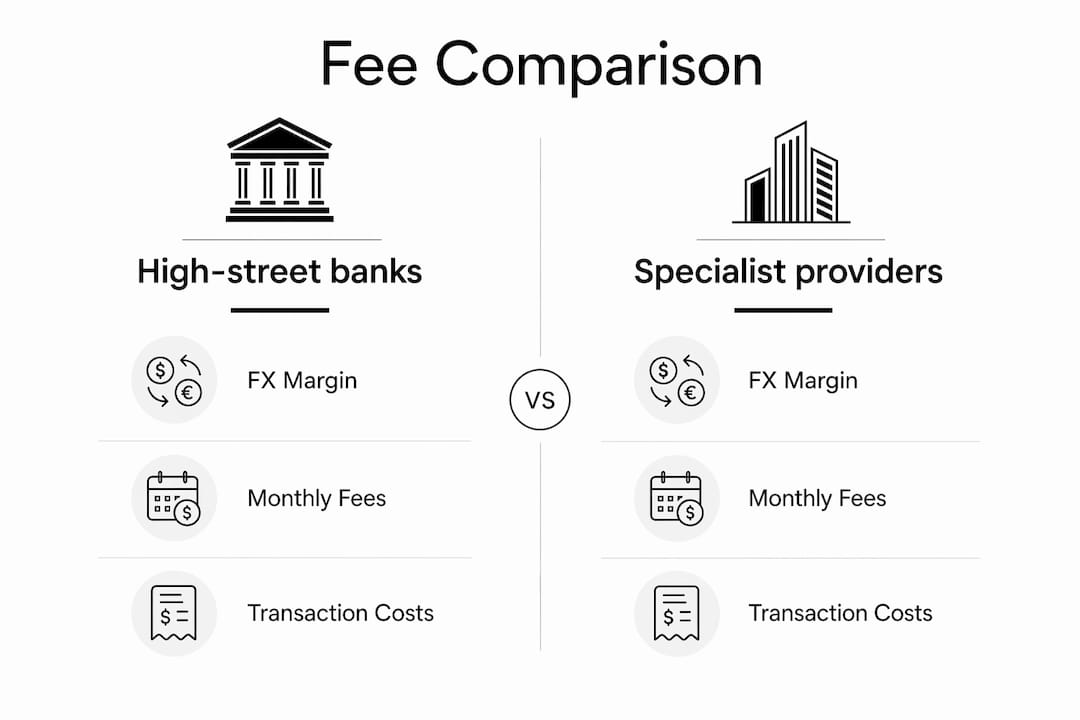
| Fee type | High-street banks | Specialist providers |
|---|---|---|
| FX conversion margin | 2.5–4% | 0.3–1.0% |
| SWIFT transfer fee | £15–£30 per transfer | Often avoidable with local details |
| Monthly account fee | Often bundled or hidden | Transparent, pay-as-you-go |
| API access | Rarely included | Standard on most platforms |
Traditional banks often offer free introductory periods but impose higher transaction costs and compliance hurdles thereafter. That initial free period can mask the true cost of operating internationally through a high-street account.
SWIFT fees deserve special attention. If your provider does not give you local receiving details for each currency, your clients must send international wires. Those wires carry correspondent bank fees, intermediary charges, and unpredictable deduction amounts. A single missing IBAN can cost your business hundreds of dollars per month in unnecessary fees.
"Businesses should keep high-street bank accounts for sterling operations and use specialist providers for the foreign currency FX leg to optimize costs and convenience." — Cambridge Currencies
This hybrid approach is the most cost-effective structure for most UK businesses. Use your existing GBP bank account for domestic sterling payments and payroll. Use a specialist multi-currency account for EUR and USD receipts, holding, and conversion.
One often-overlooked cost is accounting complexity. Foreign transactions must be converted to base currency at the official spot rate on the transaction day for tax reporting. That requirement adds administrative work at year-end, particularly for businesses with high transaction volumes across multiple currencies.
What features should you look for in a multi-currency business account?
The most important feature is local receiving details in each currency. Without a UK sort code, EU IBAN, and US routing number issued under your business name, you cannot receive domestic-like payments. Every missing detail pushes your clients toward SWIFT wires and pushes costs onto your business.
Beyond receiving details, the features that matter most are:
- Accounting integration: Direct connections to Xero or QuickBooks reduce manual reconciliation. Multi-currency account features include Xero and QuickBooks integration alongside expense controls and multi-currency balance management.
- FX transparency: The provider must show you the exact exchange rate before you confirm a conversion. Hidden spreads buried in mid-market rate calculations are a red flag.
- API access: Businesses processing high volumes need API connectivity to automate payment triggers, reconciliation, and reporting. Digital providers prioritize API integrations and transparent pricing in ways traditional banks rarely match.
- Security and regulatory standing: For UK-based accounts, check whether client funds are safeguarded under the FCA's safeguarding rules. Full FSCS protection applies to licensed banks; e-money institutions use segregated accounts instead.
- Dashboard clarity: You need to see all three currency balances, pending transactions, and conversion history in one view without switching between platforms.
Pro Tip: Ask any provider directly: "Do I get a UK sort code, EU IBAN, and US routing number under my business name?" If the answer is no or unclear, the account will not function as a true multi-currency account for international receipts.
Platforms like Sigmaplatinum address this by providing multi-currency B2B payment account access through regulated partners, with compliance-focused onboarding that includes KYB checks. That structure matters for businesses that need reliability, not just low fees.
How do you know if a multi-currency account is right for your business?
The decision depends primarily on transaction volume and currency mix. A clear framework helps:
- Fewer than 50 international transactions per month: A standard local account may be sufficient. The administrative overhead of managing multiple currency balances may outweigh the fee savings at low volume.
- 50–200 international transactions per month: A multi-currency account starts delivering clear cost advantages. FX margins and SWIFT fees begin to materially affect profit margins at this level.
- More than 200 international transactions per month: A dedicated multi-currency account becomes mandatory at this volume. The cost of not having one is measurable and significant.
Beyond volume, consider your customer currency requirements. A UK consulting firm billing European clients in euros and US clients in dollars has a direct need. An import/export business paying Asian suppliers in USD while collecting GBP from UK buyers faces the same pressure from the other direction.
Industry type also shapes the decision. Digital agencies, SaaS companies, and professional services firms with international client bases benefit immediately. Businesses operating purely in sterling with occasional foreign invoices may find a standard account with occasional FX transfers more practical.
The accounting burden is real. Each foreign currency transaction requires a spot rate conversion for tax purposes. Businesses with high volumes should factor in the cost of accountant time or software to handle this correctly before choosing a provider.
Key Takeaways
A multi-currency account holding GBP, EUR, and USD is the most cost-effective structure for any UK or international business processing more than 50 cross-border transactions per month.
| Point | Details |
|---|---|
| Local receiving details are non-negotiable | A UK sort code, EU IBAN, and US routing number prevent costly SWIFT fees on every receipt. |
| FX margins vary by 2–3.5 percentage points | Specialist providers charge 0.3–1.0% versus 2.5–4% at high-street banks. |
| Conversion timing is your control lever | Holding funds in each currency and converting when rates favor you reduces FX costs. |
| Volume determines the right account type | Fewer than 50 monthly international trades may not require a dedicated multi-currency account. |
| Accounting complexity increases with activity | Each foreign transaction requires a spot rate conversion for tax reporting, adding administrative load. |
Why most businesses get this wrong before they get it right
The most common mistake I see is businesses opening a multi-currency account and then giving clients their SWIFT details instead of their local receiving details. They have the right tool and use it the wrong way. The IBAN and routing number are the entire point. If your clients are still sending SWIFT wires, you are not getting the benefit you paid for.
The second mistake is treating FX rate comparison as the only evaluation criterion. The rate matters, but so does the reliability of the payment infrastructure, the quality of the accounting integration, and the responsiveness of support when a payment goes missing. A provider offering 0.3% spreads with unreliable settlement is worse than one offering 0.5% spreads with consistent, traceable transfers.
I have also seen founders underestimate the tax reporting requirement. Holding USD and EUR balances feels simple until year-end, when every transaction needs a spot rate applied to it. Businesses that integrate their multi-currency account directly with Xero or QuickBooks from the start avoid a painful manual reconciliation process later.
The hybrid approach works best for most UK businesses. Keep your high-street GBP account for domestic operations, payroll, and HMRC payments. Use a specialist multi-currency account for EUR and USD receipts and conversions. That combination gives you the reliability of a regulated bank for sterling and the cost efficiency of a fintech for foreign currency.
— Ahmed
Sigmaplatinum's multi-currency payment accounts for international businesses
Businesses that operate across GBP, EUR, and USD need more than a basic bank account. They need a payment infrastructure built for cross-border volume.
Sigmaplatinum provides business payment account access designed for international companies managing multi-currency transactions, FX workflows, and corporate payment tools through regulated partners. The platform's compliance-focused onboarding, including rigorous KYB checks, gives businesses the security and reliability that high-volume international payments require. Digital agencies, consulting firms, and import/export companies use Sigmaplatinum to access GBP, EUR, and USD account capabilities without the complexity of traditional banking. Visit sigmaplatinum.com to learn more about account access for your business.
FAQ
What is a GBP EUR USD multi-currency account?
A GBP EUR USD multi-currency account is a single business account that holds separate balances in British pounds, euros, and US dollars. Funds stay in each currency until you choose to convert, avoiding forced conversion on receipt.
How do local receiving details reduce my costs?
Local receiving details, such as a UK sort code, EU IBAN, and US routing number, let your clients pay you as a domestic transfer. This avoids SWIFT international wire fees, which can reach $30 per transaction.
What FX margin should I expect to pay?
High-street banks typically charge 2.5–4% on FX conversions. Specialist fintech providers charge 0.3–1.0%. The difference is material for any business converting more than £50,000 per year in foreign currency.
Do I need a multi-currency account if I only have occasional international payments?
Businesses processing fewer than 50 international transactions per month may find a standard account sufficient. Above 200 monthly transactions, a dedicated multi-currency account delivers clear and measurable cost savings.
How does a multi-currency account affect my tax reporting?
Every foreign currency transaction must be converted to your base currency at the official spot rate on the transaction date for tax purposes. Integrating your account with accounting software like Xero or QuickBooks from the start reduces the administrative burden significantly.