
International payment infrastructure is defined as the networks, systems, and protocols that move money across borders between banks, businesses, and financial institutions. The most widely recognized examples of international payment infrastructure include SWIFT, SEPA, Fedwire, FedNow, and emerging real-time rails like Pix and UPI. Understanding these systems is no longer optional for business professionals managing cross-border transactions. The right infrastructure choice directly affects settlement speed, transaction cost, and your ability to compete in global markets.
1. What are examples of international payment infrastructure?
International payment infrastructure falls into three broad categories: traditional correspondent banking networks, modern real-time domestic rails, and emerging interlinked systems. Fintech experts classify these into traditional, modern, and emerging rails to help businesses balance reach, speed, and cost. Each category serves different transaction volumes, geographies, and urgency levels. Knowing which category fits your business need is the first decision every finance team should make.
Traditional systems like SWIFT and SEPA have dominated global payments for decades. Modern rails like FedNow, Pix, and UPI now settle transactions in seconds. Emerging interoperability projects are beginning to connect these domestic systems across borders.

2. SWIFT: the world's messaging backbone
SWIFT is a secure messaging network, not a payment system. SWIFT sends payment instructions between banks, while actual settlement depends on bilateral correspondent bank accounts. This distinction explains why SWIFT transfers take multiple days and carry layered fees. The network connects over 11,000 financial institutions across more than 200 countries.
SWIFT bank wires typically settle in 1–5 business days, with fees ranging from $25 to $65 plus a 1.5%–3% FX markup. SWIFT GPI improved tracking and speed but still relies on correspondent banking chains. For large, one-off international transfers where reach matters more than cost, SWIFT remains the default choice.
Pro Tip: Request a SWIFT GPI tracker reference from your bank. It gives you real-time visibility into exactly where your payment sits in the correspondent chain.
3. SEPA: cross-border euro payments made simple
SEPA enables euro payments across 41 countries with near-instant options that settle in 5–9 seconds. It makes cross-border euro transactions as straightforward as domestic transfers. SEPA uses IBANs as the universal account identifier, eliminating the need for correspondent bank routing codes. For any business operating within the Eurozone, SEPA is the most cost-effective and predictable payment rail available.
SEPA includes two primary instruments: SEPA Credit Transfer for one-off payments and SEPA Direct Debit for recurring collections. The instant credit transfer variant, SCT Inst, delivers funds in under 10 seconds around the clock. This makes SEPA the benchmark for what modern payment infrastructure should deliver.
4. Fedwire and CHAPS: high-value domestic settlement
Fedwire is the US Federal Reserve's real-time gross settlement system for large-value transactions. It settles payments individually and immediately, making it the preferred rail for high-value, time-sensitive transfers within the United States. CHAPS is the UK equivalent, operated by the Bank of England, and handles sterling payments that require same-day finality.
Both systems support the international leg of cross-border payments by providing fast domestic settlement at each end of a transaction. A payment from a US company to a UK supplier may use Fedwire domestically, cross via SWIFT, and settle through CHAPS in the UK. Understanding this chain helps finance teams identify where delays and costs actually originate.
5. FedNow, Pix, and UPI: real-time rails reshaping global payments
More than 80 countries have deployed domestic fast payment systems that settle retail transactions in real time. FedNow launched in the US in 2023, Pix in Brazil in 2020, and UPI has processed billions of transactions in India. These systems were built for speed and low cost at the domestic level. They are now the foundation for the next generation of cross-border payment infrastructure.
Pix processes payments 24 hours a day, 7 days a week, with settlement in under 10 seconds and near-zero fees. UPI handles over 10 billion transactions per month in India, demonstrating the scale these rails can reach. FedNow enables US banks to send and receive payments at any time, removing the batch-processing delays of legacy ACH. For businesses with suppliers or customers in Brazil, India, or the US, these rails offer a materially better experience than SWIFT for domestic legs of international payments.
Pro Tip: When paying suppliers in Brazil or India, ask your payment provider whether they route through Pix or UPI domestically. The difference in speed and cost versus a SWIFT wire is significant.
6. Multi-currency fintech wallets and payment processors
Multi-currency fintech wallets and payment processors represent the most practical digital payment infrastructure for B2B cross-border transactions today. These platforms settle transactions in minutes to 24 hours, with transparent fees typically between 0.3% and 1%. That compares favorably to the 1.5%–3% FX markup on a standard SWIFT wire. For recurring, medium-size international payments, this category of infrastructure delivers the best combination of speed and cost.
The key mechanism is local currency accounts. Businesses holding local currency accounts within multi-currency platforms can bypass costly correspondent banking chains, reducing FX spreads from a typical 1.5%–3% to as low as 0.2%–0.5%. Instead of routing through 3–4 correspondent banks, the platform settles locally in the destination currency. This approach is now standard practice for digital agencies, consulting firms, and import/export companies managing high-volume international flows.
For a practical look at how these setups work in practice, the B2B cross-border payment examples from Sigmaplatinum illustrate real business configurations across multiple industries.
7. Correspondent banking: the hidden cost layer
Banks typically route cross-border payments through 3–4 correspondent banks, each adding fees and delay. This is the core inefficiency in traditional international payment infrastructure. Each intermediary bank charges a handling fee, and each hop adds settlement time. A payment that looks straightforward from the sender's perspective may pass through banks in three different countries before reaching the recipient.
The practical implication for businesses is that the fee shown at initiation is rarely the fee that arrives. Recipient banks often deduct intermediary charges from the transferred amount. Finance teams managing supplier payments need to account for this by either sending a gross-up amount or using payment rails that bypass the correspondent chain entirely.
8. Payment orchestration: routing across multiple rails
Payment orchestration acts as an intelligent layer above various rails to dynamically route payments based on cost, speed, and regulatory exposure. It allows businesses to avoid choosing between legacy and newer infrastructure by using a single integration point. A payment orchestration layer can route a $500 supplier payment through a fintech wallet while sending a $500,000 acquisition payment via SWIFT, all within the same platform.
This approach is particularly valuable for businesses operating across multiple geographies with different payment preferences. Payment orchestration removes the need to maintain separate integrations for each rail. For finance teams managing payments across Europe, Asia, and the Americas, it is the most practical way to access the full range of global payment systems without building custom infrastructure.
9. Project Nexus and the future of interlinked payment systems
Project Nexus is a Bank for International Settlements initiative designed to connect domestic fast payment systems like FedNow, Pix, and UPI into a single interoperable network. The G20 has made interlinking these domestic systems a priority specifically to reduce cross-border costs and friction by bypassing costly correspondent banking layers. The goal is to make an international payment as fast and cheap as a domestic one.
"The CPMI highlights that cross-border payment enhancement is a strategic imperative for global economic connectivity, stressing 'interoperability by design' for financial partners."
The challenge is regulatory fragmentation. Each domestic system operates under its own legal framework, currency controls, and compliance requirements. Project Nexus addresses this by creating a standardized protocol layer that sits between national systems. For businesses in underserved or fragmented regions, this development has the potential to reduce the cost of receiving international payments by a material amount within the next few years.
Key Takeaways
The most effective approach to international payment infrastructure is matching the right rail to each transaction type based on speed, cost, and geographic reach.
| Point | Details |
|---|---|
| SWIFT is a messaging network | It sends instructions but does not move funds; settlement depends on correspondent banks. |
| SEPA sets the benchmark | Euro payments across 41 countries settle in under 10 seconds via SCT Inst. |
| Real-time rails are expanding | FedNow, Pix, and UPI now cover the US, Brazil, and India with near-instant, low-cost settlement. |
| Multi-currency accounts cut costs | Local currency accounts reduce FX spreads from 1.5%–3% to as low as 0.2%–0.5%. |
| Orchestration unifies access | Payment orchestration routes across multiple rails from a single integration point. |
What I've learned about choosing payment infrastructure
The biggest mistake I see finance teams make is treating payment infrastructure as a one-size-fits-all decision. They pick SWIFT because it's familiar, then absorb the cost and delay without questioning whether a better rail exists for that specific transaction. The reality is that the right infrastructure depends on three variables: the destination country, the transaction size, and the frequency of the payment.
For recurring supplier payments in the Eurozone, SEPA SCT Inst is almost always the correct answer. For high-volume flows to Brazil or India, routing through Pix or UPI domestically cuts both cost and settlement time. For large, one-off transfers where finality and reach matter most, SWIFT still earns its place. The mistake is defaulting to SWIFT for everything.
The second thing I'd push back on is the assumption that fintech wallets are only for small businesses. The multi-currency liquidity guide from Sigmaplatinum makes this point clearly: holding local currency balances in key markets is a treasury strategy, not just a convenience feature. It reduces FX exposure and eliminates correspondent bank fees on both ends of a transaction.
The third insight is about interoperability. The CPMI's emphasis on "interoperability by design" is not abstract policy language. It is a signal that the infrastructure connecting FedNow, Pix, and UPI will mature faster than most finance teams expect. Businesses that build payment workflows on flexible, multi-rail platforms now will be better positioned to access those interlinked systems when they go live at scale.
— Ahmed
How Sigmaplatinum supports international payment access
Sigmaplatinum gives international businesses direct access to multi-currency payment accounts without the complexity of traditional banking onboarding. The platform connects businesses to regulated payment partners, enabling them to hold and move funds in multiple currencies while reducing reliance on correspondent banking chains.
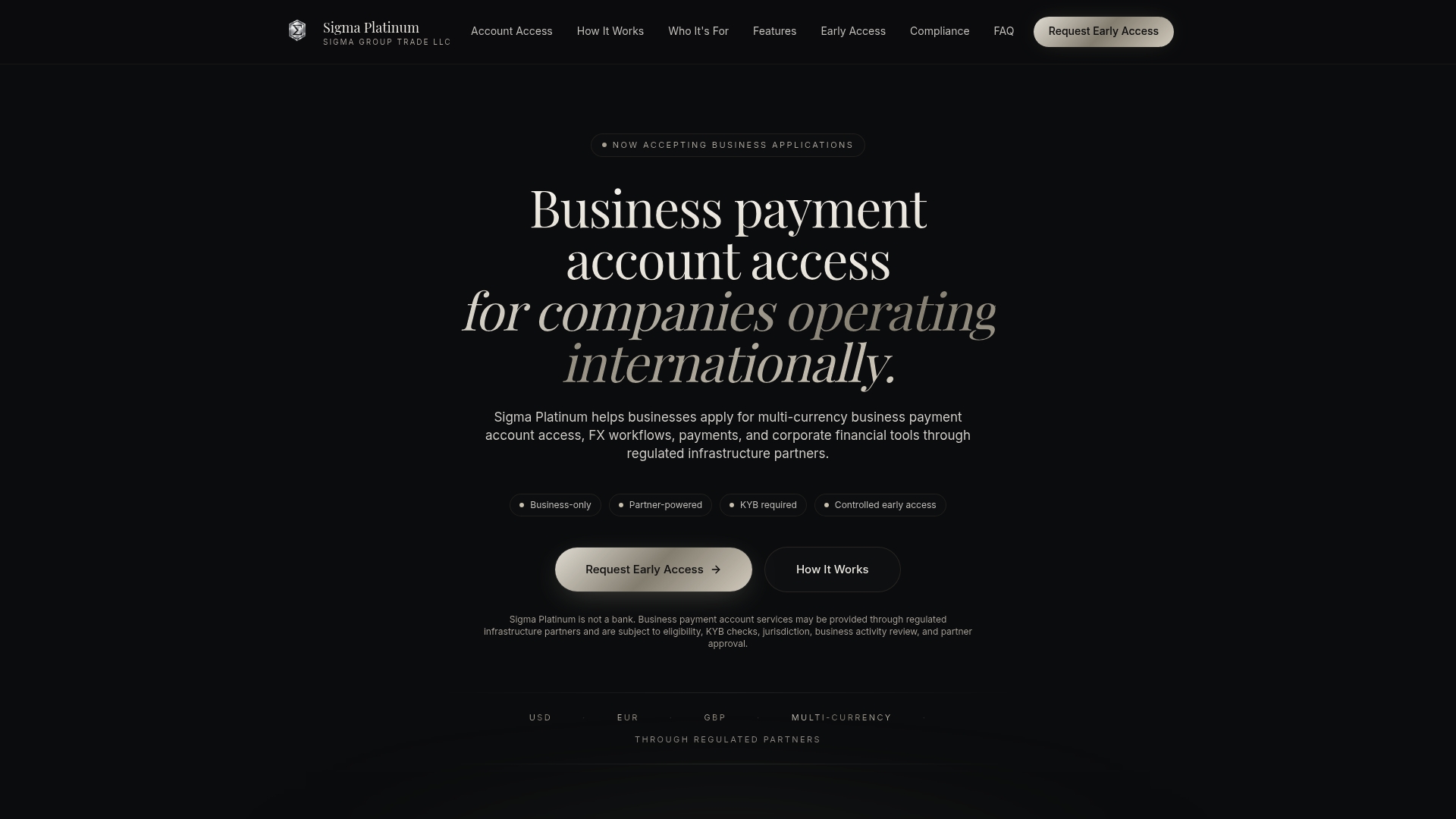
For digital agencies, consulting firms, and import/export companies, Sigmaplatinum's compliance-focused approach means faster access to the payment rails that matter. The platform's KYB process is built for legitimate international businesses that need efficient workflows, not months-long bank approvals. Businesses that want to reduce FX costs and settle cross-border payments faster can explore business payment account access through Sigmaplatinum's platform directly.
FAQ
What is international payment infrastructure?
International payment infrastructure is the collection of networks, systems, and protocols that enable money to move across borders between banks and businesses. Examples include SWIFT, SEPA, Fedwire, FedNow, Pix, and UPI.
How does SWIFT differ from SEPA?
SWIFT is a global messaging network that sends payment instructions between banks in over 200 countries, while SEPA is a payment execution system that moves euro funds across 41 countries with near-instant settlement. SWIFT relies on correspondent banks; SEPA does not.
What are the fastest cross-border payment options for businesses?
Multi-currency fintech wallets and real-time domestic rails like Pix and UPI currently offer the fastest settlement, typically within minutes to 24 hours, with fees between 0.3% and 1%.
Why do correspondent banks add cost to international payments?
Banks route cross-border payments through 3–4 correspondent banks on average, and each one charges a handling fee and adds settlement time. Businesses can avoid this by using multi-currency accounts or payment platforms that settle locally in the destination currency.
What is payment orchestration in cross-border payments?
Payment orchestration is a software layer that dynamically routes payments across multiple rails based on cost, speed, and compliance requirements. It gives businesses a single integration point to access traditional, modern, and emerging payment infrastructure simultaneously.